Showing posts with label South America. Show all posts

Wednesday, January 23, 2013

How The Sweet Potato Crossed The Pacific Way Before The Europeans Did

A well-traveled root: A vendor sells sweet potatoes at a market near Manila in 2011. The Portuguese brought the root to the Philippines all the way from the Caribbean. Enlarge image i

A well-traveled root: A vendor sells sweet potatoes at a market near Manila in 2011. The Portuguese brought the root to the Philippines all the way from the Caribbean.
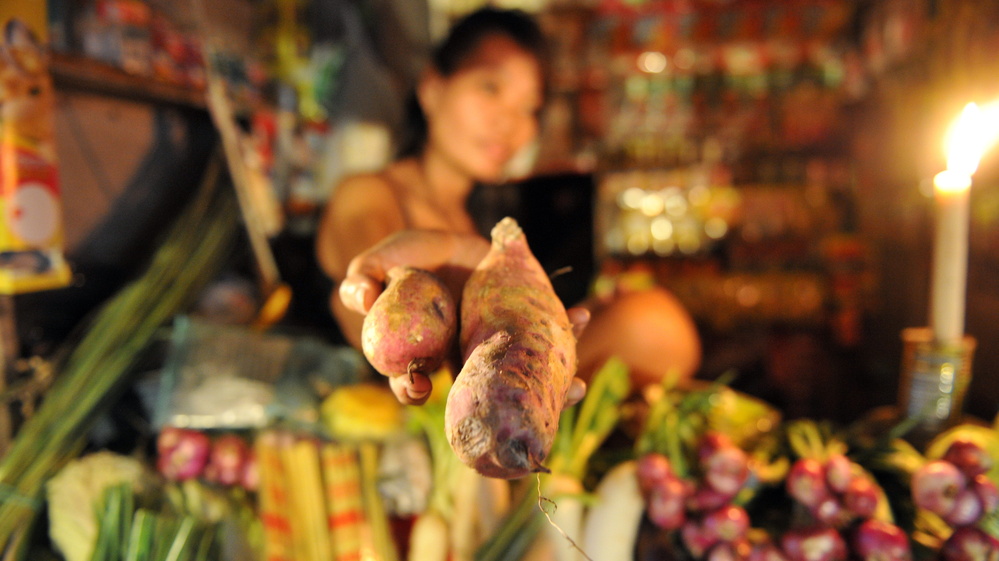
A well-traveled root: A vendor sells sweet potatoes at a market near Manila in 2011. The Portuguese brought the root to the Philippines all the way from the Caribbean.

A well-traveled root: A vendor sells sweet potatoes at a market near Manila in 2011. The Portuguese brought the root to the Philippines all the way from the Caribbean.

When it comes to spreading food around the world, Christopher Columbus and his European compatriots get most of the credit.

Yes, they introduced some quintessential ingredients into European and Asian cuisine. Who could imagine Italian food without the tomato? Or Indian and Chinese dishes without the spicy kick of chili peppers?

But anthropologists think that a few foods made the 5,000-mile trek across the Pacific Ocean long before Columbus landed in the New World. And their proof is in the potato the sweet potato.

By analyzing the DNA of 1,245 sweet potato varieties from Asia and the Americas, researchers have found a genetic smoking gun that proves the root vegetable made it all the way to Polynesia from the Andes nearly 400 years before Inca gold was a twinkle in Ferdinand and Isabella's eyes.

The findings, published in the Proceedings of the National Academy of Sciences, offer more evidence that ancient Polynesians may have interacted with people in South America long before the Europeans stepped foot on the continent.

The sweet potato made three independent trips to Southeast Asia. The Polynesians probably introduced it in 1100 A.D. (red). While the Spanish (blue) and Portuguese (yellow) brought other varieties from the Americas around 1500. Enlarge image i

The sweet potato made three independent trips to Southeast Asia. The Polynesians probably introduced it in 1100 A.D. (red). While the Spanish (blue) and Portuguese (yellow) brought other varieties from the Americas around 1500.

The sweet potato made three independent trips to Southeast Asia. The Polynesians probably introduced it in 1100 A.D. (red). While the Spanish (blue) and Portuguese (yellow) brought other varieties from the Americas around 1500.

The sweet potato made three independent trips to Southeast Asia. The Polynesians probably introduced it in 1100 A.D. (red). While the Spanish (blue) and Portuguese (yellow) brought other varieties from the Americas around 1500.

"There's been many kinds of evidence linguistic and archaeological for contact between these two people," Caroline Rouiller, an evolutionary biologist at the Center for Functional and Evolutionary Ecology in France who led the study, tells The Salt. "But the sweet potato is the most compelling."

Sweet potatoes originated in Central and South America. But archaeologists have found prehistoric remnants of sweet potato in Polynesia from about A.D. 1000 to A.D. 1100, according to radiocarbon dating. They've hypothesized that those ancient samples came from the western coast of South America. Among the clues: One Polynesian word for sweet potato "kuumala" resembles "kumara," or "cumal," the words for the vegetable in Quechua, a language spoken by Andean natives.

But until now, there was little genetic proof for this theory of how the tater traveled.

Part of the reason why is that modern sweet potatoes are a genetic muddle a hybrid of different cultivars that Europeans helped spread around the globe so it's hard to decipher their origins from their DNA.

Rouiller got around this problem by turning to dried sweet potato remains kept in a London museum. Capt. James Cook's crew picked up the vegetables in Polynesia back in 1769, before all this interbreeding took off. Examining the genetic blueprint of Cook's sweet potatoes allowed Rouiller and her colleagues to trace the root's evolution all the way back to Ecuador and Peru.

So how did the sweet potato make the ocean voyage?

Its seeds could have possibly hitched a ride on seaweed or gotten lodged in the wing of a bird. But Pat Kirch, an archeologist at the University of Berkeley, California, thinks the Polynesians were well-equipped to sail right across the Pacific to South America and pick up a potato.

"There's a lot of evidence accumulating over the last 10 years that the Polynesians made landfall in South America," he says. "We think they had sophisticated, double-hulled canoes like very large catamarans which could carry 80 or more people and be out to sea for months."

The Polynesians had sophisticated, double-hulled canoes that were built for deep sea voyages. An artist aboard Capt. Cook's ship drew a picture when they arrived in Hawaii.

The Polynesians had sophisticated, double-hulled canoes that were built for deep sea voyages. An artist aboard Capt. Cook's ship drew a picture when they arrived in Hawaii.

But Polynesians didn't just grab the potatoes and head home. There are clues that they may have introduced chickens to the continent while they were at it.

"In recent years, there is this baffling evidence that there were chickens in western Peru before Columbus," Charles C. Mann, the author of the book 1491: New Revelations of the Americas Before Columbus, tells The Salt.

But the claims have been disputed, he says, because the chicken bones date back to sometime between 1300 and 1400. "This is like three minutes before Columbus arrives," Mann jokes. "It's kind of weird that it's right before the Europeans got there."

Nevertheless, Mann thinks the sweet potato research offers exciting evidence of contact between Polynesians and people in South America.

"It would be a mind-boggling voyage," he says. "Suppose you started some place in Easter Island. It's incredible to think that you could go all the way to South America. This is scurvy time. It's a long journey and incredibly dangerous. You'd have to be completely insane which people are."

Insane? Maybe. Then again, you never know the lengths a person will go to for some sweet potato fries.


Recipes - How To Information eHow.com Recipes: Wondering whats for breakfast, lunch, or dinner? Need a side dish or appetizer to serve with your favorite recipe? Find healthy recipes, cooking tips and ... Potato - Wikipedia, the free encyclopedia The potato is a starchy, tuberous crop from the perennial Solanum tuberosum of the Solanaceae family (also known as the nightshades). The word may refer to the plant ... The Mysterious Sweet Potato of the South Pacific Vick Family Farms - Wilson NC - USA - sweet potates, sweetpotatoes, sweetpotatoes.com, fresh-cut produce, fresh-cu sweet potatoes, wholesale sweet potatoes, sweet ... press - Picca Peru Cooking Channel (Unique Eats): Mash-Ups. July 7, 2012. Were celebrating the best of all worlds with restaurants that mix different ethnic traditions to create new ... fun_and_fun_only : - 100% EnterTainMenT GuaRanTeeD !!!! ** We ArE HerE To MakE YoU SmilE ** A H eartY W elcomE to Y oU, F uN and F uN O nlY is a F riendlY M ailinG G rouP, W herE Y oU can R ecievE, FunnY PicS, WallpaperS ... Pacific Ocean Facts, information, pictures Encyclopedia.com ... Pacific Ocean largest and deepest ocean, c.70,000,000 sq mi (181,300,000 sq km), occupying about one third of the earth's surface; named by the... Pre-Columbian trans-oceanic contacts - Wikipedia, the free ... Pre-Columbian trans-oceanic contact hypotheses are those hypotheses that propose interaction between indigenous peoples of the Americas who settled the Americas ... Chinese Laborers and the Construction of the Central Pacific Chinese Laborers and the Construction of the Central Pacific. By George Kraus. Utah Historical Quarterly, Winter 1969, Volume 37, Number 1, pages 41-57.

How The Sweet Potato Crossed The Pacific Before Columbus

A well-traveled root: A vendor sells sweet potatoes at a market near Manila in 2011. The Portuguese brought the root to the Philippines all the way from the Caribbean. Enlarge image i

A well-traveled root: A vendor sells sweet potatoes at a market near Manila in 2011. The Portuguese brought the root to the Philippines all the way from the Caribbean.

A well-traveled root: A vendor sells sweet potatoes at a market near Manila in 2011. The Portuguese brought the root to the Philippines all the way from the Caribbean.

A well-traveled root: A vendor sells sweet potatoes at a market near Manila in 2011. The Portuguese brought the root to the Philippines all the way from the Caribbean.

When it comes to spreading food around the world, Christopher Columbus and his European compatriots get most of the credit.

Yes, they introduced some quintessential ingredients into European and Asian cuisine. Who could imagine Italian food without the tomato? Or Indian and Chinese dishes without the spicy kick of chili peppers?

But anthropologists think that a few foods made the 5,000-mile trek across the Pacific Ocean long before Columbus landed in the New World. And their proof is in the potato the sweet potato.

By analyzing the DNA of 1,245 sweet potato varieties from Asia and the Americas, researchers have found a genetic smoking gun that proves the root vegetable made it all the way to Polynesia from the Andes nearly 400 years before Inca gold was a twinkle in Ferdinand and Isabella's eyes.

The findings, published in the Proceedings of the National Academy of Sciences, offer more evidence that ancient Polynesians may have interacted with people in South America long before the Europeans stepped foot on the continent.

The sweet potato made three independent trips to Southeast Asia. The Polynesians probably introduced it in 1100 A.D. (red). While the Spanish (blue) and Portuguese (yellow) brought other varieties from the Americas around 1500. Enlarge image i

The sweet potato made three independent trips to Southeast Asia. The Polynesians probably introduced it in 1100 A.D. (red). While the Spanish (blue) and Portuguese (yellow) brought other varieties from the Americas around 1500.

The sweet potato made three independent trips to Southeast Asia. The Polynesians probably introduced it in 1100 A.D. (red). While the Spanish (blue) and Portuguese (yellow) brought other varieties from the Americas around 1500.

The sweet potato made three independent trips to Southeast Asia. The Polynesians probably introduced it in 1100 A.D. (red). While the Spanish (blue) and Portuguese (yellow) brought other varieties from the Americas around 1500.

"There's been many kinds of evidence linguistic and archaeological for contact between these two people," Caroline Rouiller, an evolutionary biologist at the Center for Functional and Evolutionary Ecology in France who led the study, tells The Salt. "But the sweet potato is the most compelling."

Archaeologists believe the very first sweet potatoes grew in Central and South America. But they have found prehistoric remnants of sweet potato in Polynesia from about A.D. 1000 to A.D. 1100, according to radiocarbon dating. They've hypothesized that those ancient samples came from the western coast of South America. Among the clues: One Polynesian word for sweet potato "kuumala" resembles "kumara," or "cumal," the word for the vegetable in Quechua, a language spoken by Andean natives.

But until now, there was little genetic proof for this theory of how the 'tater traveled.

Part of the reason why is that modern sweet potatoes are a genetic muddle a hybrid of different cultivars that Europeans helped spread around the globe so it's hard to decipher their origins from their DNA.

Rouiller got around this problem by turning to dried sweet potato remains kept in a London museum. Capt. James Cook's crew picked up the vegetables in Polynesia back in 1769, before all this interbreeding took off. Examining the genetic blueprint of Cook's sweet potatoes allowed Rouiller and her colleagues to trace the root's evolution all the way back to Ecuador and Peru.

So how did the sweet potato make the ocean voyage?

Its seeds could have possibly hitched a ride on seaweed or gotten lodged in the wing of a bird. But Pat Kirch, an archeologist at the University of Berkeley, California, thinks the Polynesians were well-equipped to sail right across the Pacific to South America and pick up a potato.

"There's a lot of evidence accumulating over the last 10 years that the Polynesians made landfall in South America," he says. "We think they had sophisticated, double-hulled canoes like very large catamarans which could carry 80 or more people and be out to sea for months."

The Polynesians had sophisticated, double-hulled canoes that were built for deep sea voyages. An artist aboard Capt. Cook's ship drew a picture when they arrived in Hawaii.

The Polynesians had sophisticated, double-hulled canoes that were built for deep sea voyages. An artist aboard Capt. Cook's ship drew a picture when they arrived in Hawaii.

But Polynesians didn't just grab the potatoes and head home. There are clues that they may have introduced chickens to the continent while they were at it.

"In recent years, there is this baffling evidence that there were chickens in western Peru before Columbus," Charles C. Mann, the author of the book 1491: New Revelations of the Americas Before Columbus, tells The Salt.

But the claims have been disputed, he says, because the chicken bones date back to sometime between 1300 and 1400. "This is like three minutes before Columbus arrives," Mann jokes. "It's kind of weird that it's right before the Europeans got there."

Nevertheless, Mann thinks the sweet potato research offers exciting evidence of contact between Polynesians and people in South America.

"It would be a mind-boggling voyage," he says. "Suppose you started some place in Easter Island. It's incredible to think that you could go all the way to South America. This is scurvy time. It's a long journey and incredibly dangerous. You'd have to be completely insane which people are."

Insane, maybe, but perhaps these explorers tried sweet potato fries and knew they were a culinary treasure worth taking home.


How many groups reached the Americas before Christopher Columbus? In 1492, Christopher Columbus landed in what is now the Bahamas, changing the world forever. But was he first non-indigenous person to reach the Americas? Vikings got ... Morning Glories - WAYNE'S WORD Morning Glories. The World's Most Beautiful Vines. Modified From: Pacific Horticulture 58: 15-21 by Wayne P. Armstrong (Spring 1997) Pre-Columbian trans-oceanic contacts - Wikipedia, the free ... Pre-Columbian trans-oceanic contact hypotheses are those hypotheses that propose interaction between indigenous peoples of the Americas who settled the Americas ... Root Vegetable Photos - WAYNE'S WORD Botanical vegetables include enlarged storage roots, corms, tubers and stems that are eaten by people. True botanical vegetables also include leaves, leaf stalks ... ETHNIC DIVERSITY IN AMERICA BEFORE COLUMBUS - Faculty Support Site ethnic diversity in america before columbus suggests prehistoric old world contacts (contacts) ... Recipes - How To Information eHow.com Recipes: Wondering whats for breakfast, lunch, or dinner? Need a side dish or appetizer to serve with your favorite recipe? Find healthy recipes, cooking tips and ... Sweet potato - Wikipedia, the free encyclopedia The sweet potato (Ipomoea batatas) is a dicotyledonous plant that belongs to the family Convolvulaceae. Its large, starchy, sweet-tasting, tuberous roots are an ... Oregon Gifts of Comfort and Joy: The Online Diary of a Central ... Welcome to the online diary of a Central Oregon Grandmother (me) who is busy celebrating the positive portions of her everyday life ... along with her best ...

Thursday, November 29, 2012

Quinoa Craze Inspires North America To Start Growing Its Own

The seeds of this goosefoot plant are known as quinoa, a superfood now in high demand and grown almost exclusively in South America. But some growers think they have the formula to grow it up north. Enlarge image

The seeds of this goosefoot plant are known as quinoa, a superfood now in high demand and grown almost exclusively in South America. But some growers think they have the formula to grow it up north.

The seeds of this goosefoot plant are known as quinoa, a superfood now in high demand and grown almost exclusively in South America. But some growers think they have the formula to grow it up north.

The seeds of this goosefoot plant are known as quinoa, a superfood now in high demand and grown almost exclusively in South America. But some growers think they have the formula to grow it up north.

The explosion in world popularity of quinoa in the past six years has quadrupled prices at retail outlets. But for all the demand from upscale grocery stores in America to keep their bulk bins filled with the ancient grain-like seed, almost no farmers outside of the arid mountains and coastal valleys of Peru, Bolivia, Ecuador, and Chile grow it.

But plant breeders and scientists who study the biology and economics of quinoa say that is about to change.

"We're going to see quinoa being grown all over the place soon," predicts Kevin Murphy, a Washington State University grain breeder who has spent several years developing quinoa varieties suited to America's diverse geography and climates. Murphy says it's already clear that quinoa can flourish and produce high yields in many parts of North America, and he sees "no reason why quinoa production won't take off in the next few years."

Gardiner Kevin Murphy with a goosefoot plant, the seeds of which we eat as quinoa. Enlarge image

Gardiner Kevin Murphy with a goosefoot plant, the seeds of which we eat as quinoa.

Gardiner Kevin Murphy with a goosefoot plant, the seeds of which we eat as quinoa.

Gardiner Kevin Murphy with a goosefoot plant, the seeds of which we eat as quinoa.

Small-scale farmers in the Northwest are currently testing the crop, harvesting a few pounds of quinoa each fall among their rows of vegetables and fruits and selling the seeds at farmers markets, but quinoa farming in the United States has not yet taken off in a big way for multiple reasons.

First, Murphy says, the quinoa craze is such a new phenomenon that farmers have hardly had a chance to react. As recently as six years ago, American shoppers could buy quinoa for the rice-like price of $1.50 per pound. Now, retailers get between $4.50 and $8 for every pound they sell of this nutrient-dense superfood.

So clearly, growing quinoa which is actually the seed of the goosefoot plant (Chenopodium quinoa) could be lucrative for American farmers, though only in cooler regions. Quinoa is very heat sensitive, and experienced gardeners say temperatures of 95 degrees will completely destroy a crop. Another challenge to producing quinoa is rain. If it falls during the autumn harvest time, it can ruin the crunchy, high-protein seeds by causing them to sprout.

And then there's the problem of removing the saponin, the naturally-occurring bitter layer of compounds that deter pests, but makes uncleaned seeds all but inedible to people. Special cleaning systems would have to be set up to do this, as growers in South America have learned.

To date just one sizable operation, White Mountain Farm in the Colorado Rockies, has made a big investment in the seed. "When we first started [in 1987] there was no demand for quinoa," recalls owner Ernie New, who planted 120 acres of quinoa this May and harvested 70 after a summer of destructive weather. "Nobody knew how to grow it, to clean it, to prepare it, to eat it. There was no information at all about it." Today, New says, he receives far more orders than he can meet, many from restaurants and retailers hoping to market "locally grown" quinoa.

But for now, virtually every quinoa seed eaten in the United States is imported from South America. There, almost 80,000 tons of quinoa were harvested in 2010.

Quinoa salad. Enlarge image

Quinoa salad.

Quinoa salad.

Quinoa salad.

And it's not without challenges. In Bolivia, second in production to Peru, great prosperity has come to many farmers. But communities in the Bolivian Andes that formerly lived on quinoa have become unable to afford it and are now relying more on nutritionally inferior processed foods.

And property disputes are reportedly on the rise as South American entrepreneurs often landless arrivals from the cities compete with one another for growing space in the limited arable land of the Andes as they try to cash in on the quinoa craze. Bolivian llama herders are also abandoning their flocks, once the region's natural fertilizer source, and, instead, planting quinoa. This seems already to be causing declining soil productivity.

Most South American quinoa farms are at high elevation some more than two miles above sea levelbut quinoa is a highly adaptable and versatile species, according to Oregon nurseryman Frank Morton, owner of Wild Garden Seeds near Portland.

Morton has been growing and breeding quinoa since 1984. Heat and moisture remain frequent killers of most varieties, but through selective seed saving, Morton has transformed several original types of quinoa into at least five new ones that he says can thrive in North American climates "and produce great yields on terribly poor soil." He has seen quinoa plants freeze solid overnight and continue growing after thawing making it a potential crop for mountainous regions where other fruits, grains and vegetables cannot be grown. He also has seen it grow at sea level.

Morton believes that the Rocky Mountains, much of Canada, and the Pacific Northwest all have potential as quinoa producing regions, and he says he's certain that a North American quinoa industry will soon boom.

"There is tremendous potential for quinoa," he says. "The key is simply figuring out where it will grow."


Suite101 Suite101 is a collaborative publishing community -- a diverse network of community-driven channels built by people who thrive on sharing knowledge, opinions, and ... Green Women's Lifestyle - Yahoo! Shine There are many reasons that homeowners may be looking to complete energy efficient home improvement projects such as installing double glazing and fitting insulated ... Benghazi Suspect Held in Tunisia: Report - Yahoo! News Discover Yahoo! With Your Friends. Explore news, videos, and much more based on what your friends are reading and watching. Publish your own activity and ... The New York Times - Breaking News, World News & Multimedia Find global breaking news, multimedia, reviews & opinion, business, sports, movies, travel, books, jobs, education, real estate, cars & more. "Quick, a wet paper towel!" and other stories of how my family ... In an earlier post, I mentioned that my family is my ultimate reality check. In most cases, this is true, but in certain scenarios, like the one that I am about to ... Video - Breaking News Videos from CNN.com The latest video from CNN and its networks on breaking news stories. Kathy Freston: Lose Weight And Get Healthy With The 21-Day Vegan ... There has been an incredible amount of science coming out of late in support of a plant-based diet, and how it helps you to lose weight and turn your ... www.travelinsider.co.uk ALL DESTINATIONS Alaska: Anchorage. Arizona: Grand Canyon NP Phoenix & Scottsdale Tucson . California: California Wine Country Death Valley & Mojave Lake Tahoe Los ... The Chart - The Online Roots of Rock The Online Roots of Rock presents THE CHART a 350-year timeline showing the 3 streams of music in America: white roots music; black roots music; and the 'popular ... Health News & Articles Healthy Living - ABC News Get the latest health news from Dr. Richard Besser. Here you'll find stories about new medical research, the latest health care trends and health issues that affect ...