Showing posts with label PepsiCo. Show all posts

Monday, January 28, 2013

How One Man Tried To Slim Down Big Soda From The Inside

PepsiCo's product line ranges from salty chips and its sugary namesake drink to more healthful fare like hummus and yogurt. In 2010, the company announced plans to cut sugar, fat and sodium in its products to address health and nutrition concerns. Enlarge image i

PepsiCo's product line ranges from salty chips and its sugary namesake drink to more healthful fare like hummus and yogurt. In 2010, the company announced plans to cut sugar, fat and sodium in its products to address health and nutrition concerns.
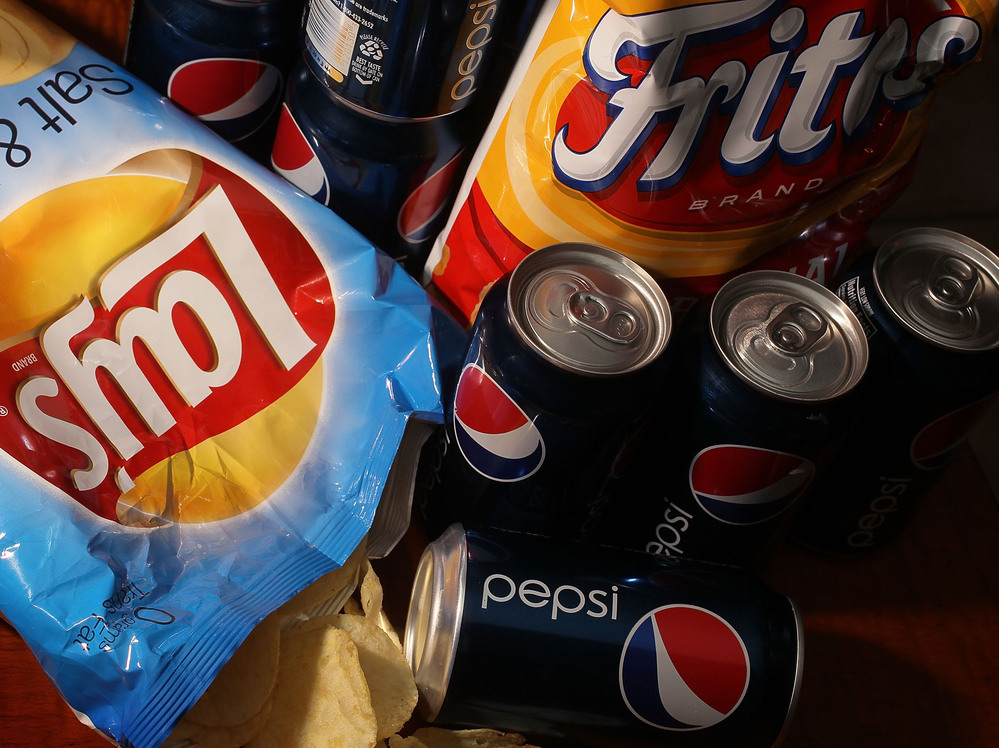
PepsiCo's product line ranges from salty chips and its sugary namesake drink to more healthful fare like hummus and yogurt. In 2010, the company announced plans to cut sugar, fat and sodium in its products to address health and nutrition concerns.

PepsiCo's product line ranges from salty chips and its sugary namesake drink to more healthful fare like hummus and yogurt. In 2010, the company announced plans to cut sugar, fat and sodium in its products to address health and nutrition concerns.

Many big food companies are caught in a dilemma these days. They want to rebrand themselves as merchants of health Coca-Cola's new anti-obesity ads are just the latest example but many of their profits still come from products that make nutritionists scowl.

If there's one person who symbolizes this tension, it's Derek Yach.

A decade ago, Yach, a soft-spoken doctor from South Africa, was building a reputation as a thorn in the side of the global food industry.

He was working at the World Health Organization in Switzerland, leading the WHO's new effort to take on health problems that come from smoking or from unhealthful diets.

Among the academic experts who got to know Yach during those years was Marion Nestle, a nutrition professor from New York University. "He was putting enormous pressure on food companies to stop marketing junk foods to kids," she recalls. "I saw him as someone who saw the food industry as an enormously destructive force in public health."

But Nestle may have misunderstood Yach. Yach himself says that food companies were never the enemy.

The strategy for dealing with the food industry, he says, was very different from his tactics for fighting tobacco. The anti-tobacco formula was simple: "Demonize the industry. Tax it through the roof. Ban all forms of marketing."

But you can't get the same results with sugary soft drinks, he says. If you tax them heavily enough, you can drive consumers away from those products, "but that doesn't mean you solve the obesity problem. It all depends on what they choose as that alternative."

With food, there's always an alternative another sugary product on the shelf.

Food companies create this universe of options, which is why Yach felt that he needed to talk to those companies, draw them in, persuade them to offer consumers better alternatives.

But he says he never, ever, thought he'd actually go work for one of those companies until one day in 2006. He'd left the WHO and was working at the Rockefeller Foundation in New York. He got a call from Indra Nooyi, who had just been named CEO of PepsiCo.

"She had the most powerful vision of how she wanted to transform the company," he recalls.

PepsiCo sells Pepsi, of course. And Mountain Dew, Frito-Lay chips, Doritos, Cheetos, and Cap'n Crunch. But PepsiCo had also picked up Tropicana orange juice and Quaker Oats. In fact, Nooyi wanted to transform the company's entire product line. "Her vision was very clear. There was an opportunity to turn this into the healthiest food and beverage company in the world."

She wanted Yach inside the company, pushing everybody toward that goal.

He took the job. He felt like he had to.

Nestle and a lot of other former allies in the public health community were stunned.

"I couldn't believe it," she says. "I was really astounded. I mean, it's not like he went to work for a company that's selling carrots! He went to work for a company that's selling sugar water!"

With that choice, Yach became the symbol of a very controversial idea: that companies like Pepsi can be part of the effort to get people to eat better.

Yach stayed at Pepsi for almost six years. He left a few months ago.

While he was there, he says, he pushed for changes in some of the company's products to make them more healthful, like potato chips with less salt and fat, and beverages with little or no sugar in them.

He got very different reactions to this idea in different parts of the company. Some took it almost as a personal attack.

"People very much loved and believed in their brands. They couldn't believe that there could be anything wrong [with them] or that they should be reducing the way that they market or sell these delightful, tasty brands," he says. But Yach stuck to his guns. "I said, 'We've got to change our marketing strategies. We've got to lower salt, sugar, fat,' repeatedly, over and over."

The food technologists, on the other hand, became Yach's allies. They took on the challenge of making a low-sodium snack that still tastes salty or a soda that's sweet without the calories. This is true throughout the food industry, Yach says. "There are pockets of people who are spending their entire lives trying to reformulate as fast as possible."

PepsiCo has, in fact, adopted some ambitious long-term goals for cutting salt, sugar and fat from its products.

But when it came to making changes right now launching new products, putting marketing muscle behind them, changing recipes Yach's goals ran into the limits of what the company was prepared to do.

Executives often got cold feet, because all of those things cost money. And pulling full-calorie Pepsi off the shelves certainly wasn't an option.

"You can't just withdraw from markets. That would simply be giving up market share to a competitor. That wouldn't be permitted by a shareholder," Yach says.

Despite all that, and even though he's no longer a PepsiCo employee, Yach remains convinced that companies like PepsiCo can, in fact, help people change their diets for the better.

He points out that PepsiCo is cutting salt from its products. It's selling a lot more reduced-calorie beverages. And it's now in the hummus and yogurt business.

The change isn't happening as fast as Yach would like, but it is happening, because it's good business in the long run, he says. People's expectations are changing. The arc of history, as he puts it, is pointing food companies toward more concern for health.

Nestle, though, thinks Yach is well-meaning but naive. PepsiCo hasn't changed that much, she says. The company's sugary soft drinks are still adding to obesity worldwide.

In fact, she says, Yach actually has hurt the cause of public health by giving the company more credibility. "He was a much greater asset to Pepsi-Cola than Pepsi was to him, or to public health."

Yach has moved on now, to a company called the Vitality Group. It's part of a health insurer in South Africa.

The Vitality Group finds ways to pay people to do healthful things like eat more fruit and vegetables or exercise. It makes money doing this, because it then has to pay fewer medical bills.

This is an industry, apparently, that really can capture profits by promoting better health.


Monday, December 3, 2012

Can Big Food Kick Its Obesity Habit? Does It Really Want To?

A sign protesting a beverage tax in Richmond, Calif. The U.S. soft drink industry has fought proposals that would put a tax on sugar sweetened beverages like sodas and energy drinks. Enlarge image

A sign protesting a beverage tax in Richmond, Calif. The U.S. soft drink industry has fought proposals that would put a tax on sugar sweetened beverages like sodas and energy drinks.

A sign protesting a beverage tax in Richmond, Calif. The U.S. soft drink industry has fought proposals that would put a tax on sugar sweetened beverages like sodas and energy drinks.

A sign protesting a beverage tax in Richmond, Calif. The U.S. soft drink industry has fought proposals that would put a tax on sugar sweetened beverages like sodas and energy drinks.

A few days ago, two big names in food policy squared off for a formal debate on the following proposition: There is a fundamental and irreconcilable conflict between the food and beverage industry's interests and public health policy interests on obesity.

Kelly Brownell,who leads the Yale Rudd Center for Food Policy and Obesity, led the anti-industry charge. He was opposed by Derek Yach, a soft-spoken South African who provoked much head-scratching in 2007 when he left the World Health Organization to take a senior executive job at PepsiCo. (Yach recently left PepsiCo to join The Vitality Group, an arm of a South African insurance company that promotes wellness.)

The proposition they debated contained some hidden historical spice. At the close of the debate, moderator Thomas Bollyky revealed that it was lifted from a landmark international treaty called the Framework Convention on Tobacco Control (FCTC), adopted in 2003. The words "tobacco industry" were simply replaced by "food and beverage industry," and "on obesity" added. (Interestingly, Yach was one of the architects of this treaty while at the WHO.)

So is PepsiCo really today's Phillip Morris?

Brownell certainly thinks so. At the debate, sponsored by the Council on Foreign Relations and held in its posh midtown Manhattan building, Brownell argued that food companies are fundamentally untrustworthy. He pointed to cases in which the industry set up front groups to fight a soda tax in California and fought national guidelines that would restrict the marketing of unhealthy food to children.

Perhaps because Yach stood beside him, or perhaps because of the pompous surroundings David Rockefeller gazed down on the speakers from an enormous portrait on the wall Brownell kept his rhetoric rather muted. In an article that he authored earlier this year, on the other hand, he hinted at parallels with Munich, 1938: "When the history of the world's attempt to address obesity is written, the greatest failure may be collaboration with and appeasement of the food industry."

The food industry can do some good things, Brownell admitted, when it comes to fighting hunger or promoting sustainable agricultural practices. But "obesity is a different kettle of fish" because it results from the industry's most basic imperative: To sell more food. All of the industry's much-celebrated "healthy eating" campaigns and partnerships with public health initiatives, Brownell says, amount to "baby steps" that simply obscure this basic fact. Brownell dismissed the idea that companies can prosper by selling better, healthier, more expensive food. There's no evidence, globally, that this market will be more than a niche, he said.

Yach, for his part, didn't bother trying to defend the entire industry or its current practices and products. He pointed, instead, to signs of a future till unfolding.

The real parallel to obesity isn't tobacco, Yach said, but climate change - a problem that will demand the expertise of industry. Just as energy companies once were focused just on selling more oil, "the multinational food and beverage business model have favored quantity over quality," he admitted. And just as energy companies are now investing in green energy, the food industry is starting to realize "that this must change if if is to survive and prosper. I witnessed the intensity of change while at PepsiCo for the last five years."

The market share of mid- and low-calorie beverages in PepsiCo's lineup, he said, was only 25 percent five years ago. Today, it is 50 percent, and "is likely to reach 75 per cent within the next five to eight years. And this is happening even in a recession, in a climate where short-term pressures are intense."

Yach's most powerful words came near the end of the debate, in impromptu remarks that he added to his prepared script. The debate, by this time, had turned to the question of whether food industry representatives should be barred from policy-making discussions related to food, similar to a ban that governments have placed on scientists sponsored by the tobacco industry.

Yach argued that the food industry is already changing, and there's more change in store, if the conversation continues.

"We have to recognize that drawing opponents into debate changes them forever," he said. "I saw that happen in South Africa [with apartheid]. And I don't think that obesity is a bigger problem than what could have happened in South Africa, if you hadn't gone down the road of constructive engagement. ... We need more engagement, not less."


Whole Health Source: Food Reward: a Dominant Factor in Obesity ... Reward Centers can Modify the Body Fat Setpoint Dopamine is a neurotransmitter (chemical that signals between neurons) that is a central mediator of reward ... Health News & Articles Healthy Living - ABC News With 250 percent of the RDA of vitamin C, a papaya can help kick a cold right out of... Addicted to food? How to break your habit - TODAY Health - TODAY.com Addicted to food? How to break your habit When does a craving become an obsession? Daryn Eller from Prevention examines how some woman were able to change their ... Nutrition Articles - Find Nutrition Related Articles on ... Healthy eating habits mean good nutrition. Go over our nutrition articles and widen your horizons. Look at how ginseng has become very important in nutrition. Why did Oz make such a big deal about this superfruit? Get the ... ACAI BERRY AND WEIGHT LOSS In addition to being rich in nutrients like Omega 3 fats and fiber, and having the highest levels of antioxidents of any food, Meg Wolff: 7 Tips to Kick the Sugar Habit (PHOTOS) Before you dismiss these tips, saying you just can't or just don't want to stop eating sugar -- please consider whether any of the following applies to you ... Kirstie Alley - Established 1914 - SEE THE CLEARWATER SUN ON JAY ... A New Look At MoneyThe U.S. Court of Appeals for the District of Columbia has ruled in favor of the American Council of the Blind. Unlike European money which has ... Ran Prieur November 28. Something big that I've been putting off for a week, and loosely related to yesterday's subject, the latest View from Hell post: Fungibility and the Loss ... Expert Nurse - Weight Loss Motivation & GoalsSome of what you'll ... Weight Loss Motivation & Goals. Some of what you'll learn is basic common sense, buthopefully you'll gain some insight into how you can change your bad eating habits ... The Law of Attraction Explanation - Having good physical health ... Having good physical health plays a big part in living a wealthy life. You can have millions of dollars and still be miserable due to poor health.