 Enlarge image i
 When times are tough, that prehistoric urge to splurge on high-calorie treats like M&Ms still kicks in.
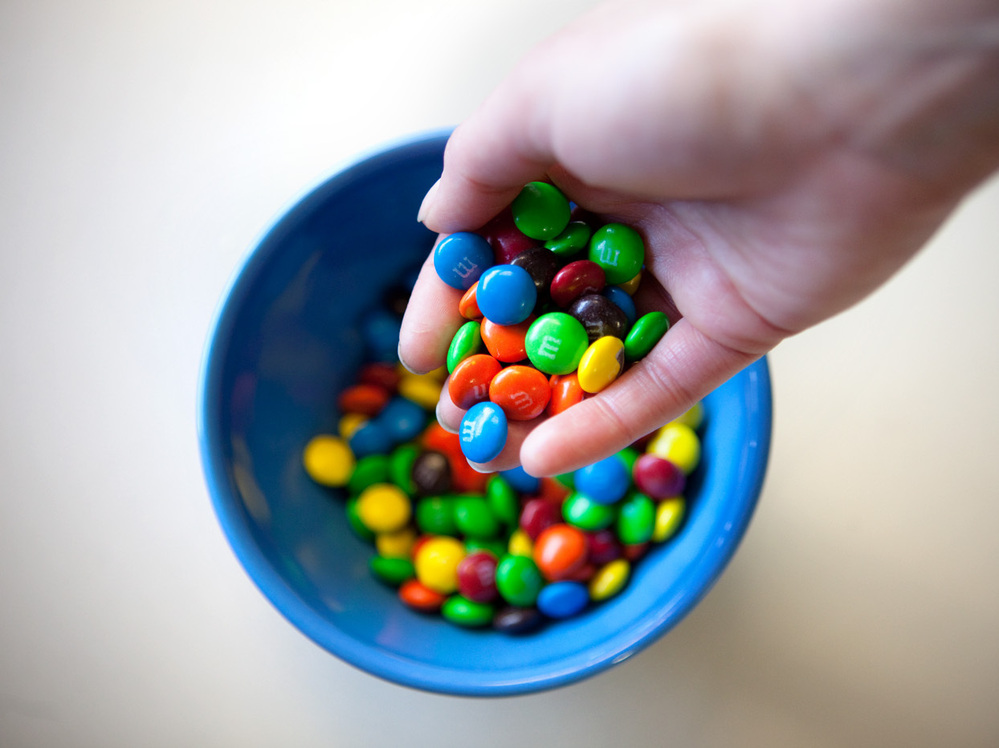
When times are tough, that prehistoric urge to splurge on high-calorie treats like M&Ms still kicks in.
Has the recession made you fat?
To the long and growing list of risk factors known to increase the risk of obesity, scientists recently added a new one: scarcity.
People given subtle cues that they may have to confront harsh conditions in the near future choose to eat higher-calorie food than they might do otherwise, a response that researchers believe is shaped by the long hand of evolution.
Evolutionary biologists have long speculated that in prehistoric times, when the blueprint of modern human behavior was created as our ancestors struggled for survival, gluttony may have been a useful response to scarcity: If you knew or feared a famine was coming, it made sense to tuck away as many calories as possible to prepare for it.
That response, while perfectly suited for prehistoric times, is maladaptive today, when more people in wealthy countries such as the United States are dying from diseases related to obesity rather than starvation. But behavior is not easily changed: The experience of food surplus is a relatively recent development in our history, and ancient rules about how to respond to adversity are likely hardwired into the brain. Our evolution hasn't had a chance to catch up, if you will, to dramatic changes in our ecosystems.
Here's the evidence for the theory that subtle cues about environmental adversity could be partly behind our nation's obesity epidemic: Researchers recently stopped 121 pedestrians on a college campus and asked them to participate in a study. The volunteers were given a bag of M&Ms; some were told the M&Ms were high calorie and some were told their M&Ms were low-calorie.
The researchers then exposed the volunteers to unconscious signals words that indicated harsh environmental conditions such as "survival," "withstand," "persistence," "shortfall," "struggle" and "adversity." When subtly prompted in this way to think about harsh conditions, volunteers given the high-calorie M&Ms ate nearly twice as many as volunteers given the low-calorie M&Ms.
In a paper published in the journal Psychological Science, researchers Juliano Laran and Anthony Salerno at the University of Miami suggested this meant that "high calorie foods, which are useful when resources are scarce, are consumed in larger quantities when an environment is perceived to be harsh, whereas low-calorie foods are consumed in smaller quantities."
In a second experiment, the researchers found that when volunteers subtly induced to think about harsh environmental conditions were also made to feel that they were starved of resources, they consumed more calories than volunteers who had been induced to think about harsh environmental conditions but were not given a feeling of scarcity.
Of course, it's not all biology. Other factors such as opportunity and less exercise may also play a role in why we stock up on calories during hard times, Marcia Pelchat of the Monnell Chemical Senses Center in Philadelphia told us last year.
Laran and Salerno suggest that one implication of their new research is that people's life history needs to be a part of understanding their struggles with obesity and dieting: Not all heavy-eaters are gluttonous and hedonistic a history of scarcity can make people vulnerable to overeating.
They point out that current public health approaches to obesity largely assume people would choose to eat less when they are given information about the amount of calories in various foods.
But posting calories on menus, most recently McDonald's, may not really decrease consumption of high-calorie foods. "In fact, making the high number of calories in a food item salient may draw people to it," the researchers wrote.
"The key is to understand that the choice of unhealthy food is not always the result of a willingness to indulge but can sometimes be the result of exposure to information suggesting environmental harshness."
Sometimes, in other words, reaching for that last french fry when you're already full may not be entirely your fault.
