Showing posts with label Monsanto. Show all posts

Monday, February 18, 2013

Farmer's Fight With Monsanto Reaches The Supreme Court

Vernon Hugh Bowman lives outside the small town of Sandborn, Ind.

Vernon Hugh Bowman lives outside the small town of Sandborn, Ind.

This week, the Supreme Court will take up a classic David-and-Goliath case. On one side, there's a 75-year-old farmer in Indiana named Vernon Hugh Bowman; on the other, the agribusiness giant Monsanto.

The farmer is fighting the long reach of Monsanto's patents on seeds but he's up against more than just Monsanto. The biotech and computer software industries are taking Monsanto's side.

Bowman also is battling a historic shift that's transformed the nation's seed business over the past 20 years.

Despite all that, Bowman seems remarkably cheerful about his situation. "Confrontation does not take a toll on me!" he says. "You and me can argue about the Bible; we can argue about religion. I'll pound my fist and we can argue all day, and I won't lose a bit of sleep at night!"

Bowman is leaning back in an easy chair, where he says he also sleeps at night. He lives alone in a modest white frame house outside the small town of Sandborn, in southwestern Indiana.

Out back, there's an array of old farm equipment collected during decades of growing corn and soybeans.

Bowman is wearing a Monsanto hat. It's probably an ironic gesture, but in fact, he's been a pleased and loyal customer of the company's seeds. He thinks the genes that Monsanto inserted into soybeans are just great. They let soybeans survive the country's most popular weedkiller: glyphosate, also known as Roundup. He can spray that one chemical to get rid of the weeds without harming his crop.

"It made things so much simpler and better. No question about that," he says.

Bowman uses these "Roundup Ready" soybeans for his main crop, which he plants in the spring, and he signs a standard agreement not to save any of his harvest and replant it the next year. Monsanto demands exclusive rights to supply that seed.

Bowman bought ordinary soybeans from this small grain elevator and used them for seed.

Bowman bought ordinary soybeans from this small grain elevator and used them for seed.

But here's where Bowman got into trouble: He also likes to plant a second crop of soybeans, later in the year, in fields where he just harvested wheat.

Those late-season soybeans are risky. The yield is smaller. Bowman decided that for this crop, he didn't want to pay top dollar for Monsanto's seed. "What I wanted was a cheap source of seed," he says.

Starting in 1999, he bought some ordinary soybeans from a small grain elevator where local farmers drop off their harvest. "They made sure they didn't sell it as seed. Their ticket said, 'Outbound grain," says Bowman.

He knew that these beans probably had Monsanto's Roundup Ready gene in them, because that's mainly what farmers plant these days. But Bowman didn't think Monsanto controlled these soybeans anymore, and in any case, he was getting a motley collection of different varieties, hardly a threat to Monsanto's seed business. "I couldn't imagine that they'd give a rat's behind," he snorts.

Bowman told his neighbors what he was doing. It turned out that Monsanto did, in fact, care.

"He wanted to use our technology without paying for it," says David Snively, Monsanto's general counsel.

Monsanto took Bowman to court, and Bowman was ordered to pay Monsanto $84,000 for infringing the company's patent.

Bowman appealed. To the surprise of many, the highest court in the land agreed to hear his case. "I'm not a-gonna give in! Because I think I've done nothing wrong!" says Bowman.

His lawyers, who are representing him for free, have come up with a legal argument for why he did nothing wrong. If they succeed in persuading the court, it could pull the rug out from under Monsanto, and some other industries, too.

Bowman's lawyer, Mark Walters from the firm of Frommer Lawrence and Haug, says there's a very old principle in patent law: If you buy something that's covered by a patent let's say it's a cell phone you own it, outright. "You're allowed to put it on Craigslist and sell it, you're allowed to use it for your 'ordinary pursuits of life' is the quote from some of the old cases that we're relying on."

It's a valuable principle, Walters says. "Imagine how commerce would work if patents owners could come out of nowhere and surprise purchasers and tell them, 'Oh, you need to pay me a royalty, because I own a patent on this thing that you just bought.'"

So according to this principle of "patent exhaustion," Bowman bought that seed and can do with it what he wants. Patent holders have no right to stop him.

Monsanto's David Snively, for his part, says this argument completely misses the point. Yes, we can buy an iPhone and do whatever we want with it, "but we're not going to go out and make copies of the iPhone and put Apple out of business," he says.

That's what Bowman did, says Snively. When he planted this patented seed, he made copies of it.

In fact, he says, if farmers were allowed to do this with patented seeds, the patents would be worthless.

A number of industry organizations have come to Monsanto's defense, including the Biotechnology Industry Organization.

Hans Sauer, deputy general counsel at BIO, says many biotech products are a lot like seeds. "They are easily replicated. They are difficult to make, but once created they are relatively easy to reproduce." The same is true of computer software.

Nels Kasey, co-owner of Great Heart Seed, with some of his company's soybean varieties.

Nels Kasey, co-owner of Great Heart Seed, with some of his company's soybean varieties.

But these are new technologies. Farmers' seeds are old; they're the original self-replicating technology, and for centuries, nobody tried to claim them as intellectual property.

That's one reason why Monsanto's patents and lawsuits against farmers have stirred up so much anger and received so much attention.

What's less well known, however, is that the practice of patenting seeds has moved far beyond Monsanto and other biotech companies.

It's standard practice now even among small companies like Great Heart Seed, in Paris, Ill.

Great Heart Seed's warehouse is filled to the rafters with white bags of soybean seed. The company sells 45 different varieties in all. Some grow better in the south, others in the north. Most have Monsanto's Roundup resistance genes, while others do not.

Yet all of these varieties are patented. "Nearly everything out there has a patent on it now," says Nels Kasey, one of the Great Heart's owners.

Twenty years ago, that wasn't the case. Many seed dealers sold "public" varieties that came from breeders at universities like Iowa State or Purdue.

Today, most new varieties come from private companies, and even universities acquire patents on most of the varieties that they do release.

Farmers aren't supposed to save and replant those seeds, either.

Kasey says, the new system gives soybean breeders and seed companies more profits, and a stronger incentive to create and sell even better plant varieties. "I'm really proud of the varieties that we have today. When I started in this company, you had a handful of varieties. Today, there's more money in it, more profit in it, so I can support 45 lines," he says.

Those seeds, though, are also more expensive. Soybean seeds have tripled in price over the past 20 years. And a farmer like Bowman who just wants some cheap, generic seeds can't easily find them.

Bowman can see towering bins filled with soybeans all around southwestern Indiana, but according to the seed companies, he can't plant any of them.

In fact, after Monsanto took Bowman to court, his search for unrestricted seeds took him all the way to Ohio, one of the very few places in the country where the state still distributes non-patented soybean varieties.

Bowman acquired some of that seed a variety called Dennison and grew it last year. He saved part of his harvest. Those soybeans are now sitting in an old combine in a shed behind his house.

If the Supreme Court rules against him, Bowman can still use those beans for seed this year.


Organic Consumers Association: Millions Against Monsanto Campaign The Millions Against Monsanto Campaign Challenging the Biotech Bully of St. Louis Home - Supreme Court of the United States supremecourtus.gov is the official web site for the Supreme Court of the United States. This site is a source for information about the Supreme Court Cases, Oral ... Monsanto v. Food Inc. over How to Feed the World - BusinessWeek Anyone whos seen the documentary Food Inc. knows that Monsanto comes across as a thug. Its bioengineered soybeans, designed to be unaffected by Monsanto ... Organic Consumers Association: Millions Against Monsanto GMO Food Fight: Round Two 2013. by Ronnie Cummins - Common Dreams, 1-3-2013 ; On November 6, in the wake of one of the most expensive and scurrilous smear campaigns ... Monsanto vs Schmeiser Profile of the litigation between Percy Schmeiser and Monsanto with regard to Roundup-ready canola. News releases of this an similar cases in Federal Court of Canada. Monsanto's Harvest of Fear - Vanity Fair Feature article on the company's hardball legal tactics against farmers and co-ops, and Monsanto's attempt to disown responsibility for production of toxic chemicals ... Farmers in OSGATA vs Monsanto Tell Obama to Stop GMO Salmon Last week, Food Democracy Now! was honored to join family farmers and fellow plaintiffs in travelling to Washington, D.C. to take part in our court appeal, Organic ... 300,000 Organic Farmers Sue Monsanto in Federal Court 'Willie Nelson, President of Farm Aid, has recently called for the national Occupy movement to declare an 'Occupy the Food System' action.... Hundreds of citizens ...

Tuesday, January 15, 2013

Monsanto Lawyer Suggests New Standard For Suing Farmers

To spray or not to spray? That may be the question on which Monsanto's arguments against farmers hangs. Enlarge image i

To spray or not to spray? That may be the question on which Monsanto's arguments against farmers hangs.

To spray or not to spray? That may be the question on which Monsanto's arguments against farmers hangs.

To spray or not to spray? That may be the question on which Monsanto's arguments against farmers hangs.

For years, the biotech giant Monsanto has provoked outrage among its critics for suing farmers who save and replant seeds from the company's patented Roundup Ready crops, such as soybeans and canola.

Some of that outrage is based on a decade-old case in Canada, in which a court ruled that a farmer, Percy Schmeiser, violated Monsanto's patents by planting canola that he "knew or ought to have known" contained Monsanto's Roundup Ready gene. Schmeiser argued that he didn't want the gene in his fields, and that it had become incorporated into his canola via wind-blown pollen.

Monsanto won that case, but the company might have been better off losing because the victory has been a public relations disaster. Around the world, many people now believe, mistakenly, that Monsanto is suing farmers for growing patented seeds that wandered into their fields without the farmers' knowledge and against their will.

So it caught our attention last week when a lawyer representing Monsanto in federal court seemed to admit that suing Schmeiser had been a mistake that the company would not repeat.

The lawyer for Monsanto, Seth Waxman, was being questioned by Judge William Bryson, from the U.S. Appeals Court for the Federal Circuit. In the case, a group of mostly organic farmers had hauled Monsanto into court, claiming that they are being damaged by the possibility that Monsanto might sue them. Bryson wanted to know what actions would convince Monsanto to sue a farmer, and Waxman came up with this:

"In the real world, Judge Bryson, the cases Monsanto brings are cases in which it has come to learn that the farmer is not purchasing any Roundup Ready seed, but is spraying his fields with Roundup, and the plants are surviving. If the farmer were not spraying, by definition he wouldn't be taking advantage of Monsanto's technology."

A farmer holding Monsanto's Roundup Ready soybean seeds at his family farm in Bunceton, Mo. Enlarge image i

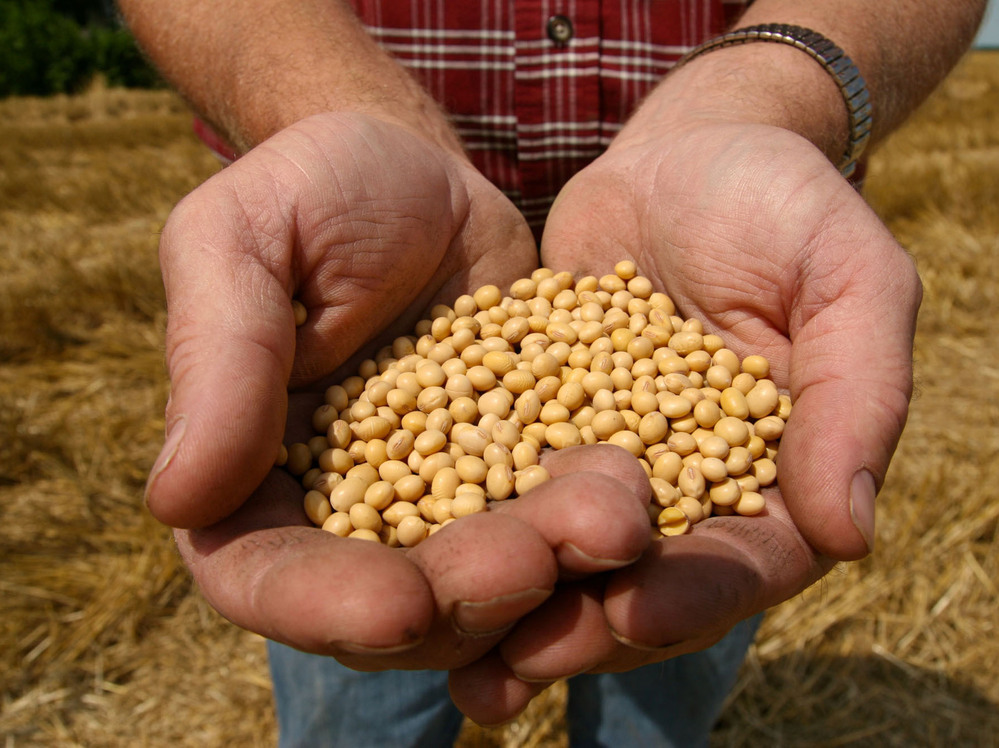
A farmer holding Monsanto's Roundup Ready soybean seeds at his family farm in Bunceton, Mo.

A farmer holding Monsanto's Roundup Ready soybean seeds at his family farm in Bunceton, Mo.

A farmer holding Monsanto's Roundup Ready soybean seeds at his family farm in Bunceton, Mo.

Under Waxman's common-sense standard, Monsanto wouldn't have brought its case against Schmeiser. That's because in that case, the company did not produce any evidence that Schmeiser was taking advantage of Monsanto's technology by spraying his crop with Roundup.

We called several lawyers to see whether Waxman's statement in court had any legal standing and would prevent any Schmeiser-style lawsuits in the future. They tell us that Monsanto isn't bound by Waxman's words, because he's just a hired lawyer thinking on his feet in a courtroom, not a company executive.

The judges in this case, however, might conceivably take up this point in their eventual decision. If they follow Waxman's lead and write, for instance, that farmers don't infringe Monsanto's patents unless they are "taking advantage" of those genes and getting some benefit from them, it would be more significant. But Daniel Ravicher, who argued the case against Monsanto for the group of organic farmers, says even such an opinion wouldn't completely change the legal landscape, because other judges, in other courts, still could disagree.

Meanwhile, the battle continues. The U.S. Supreme Court is about to take up another high-profile Monsanto seed case involving patent infringement. Oral arguments are scheduled for February 19.


Leslie Hatfield: WATCH: Organic Farmers Sue Monsanto, Hundreds ... Happy New Year! 13 Quotes To Inspire A ... Monsanto employs a fleet of lawyers and took 144 farmers to court ... they should not be allowed to sue farmers caught in ... Monsanto vs. U.S. Farmers - The Center for Food Safety ... research and numerous interviews with farmers and lawyers, CFS found that Monsanto, ... Monsanto vs. U.S. Farmers chapter New ... does not bar Monsanto from suing ... Family Farmers Take on MonsantoWill They Get Justice ... ... New Mexico, Colorado, ... the farmers are pre-emptively suing Monsanto and seeking court ... IT COULD REQUIRE HIGHER STANDARDS OF PROOF FOR MONSANTO TO ... Monsanto Wins Patent Dispute Against Farmer Who Bought Legal Seeds ... ... once Monsanto has given farmers the rights to sell second ... because the seeds Bowman planted are new ... Monsanto needs to sue its own plants ... 300,000 Organic Farmers Sue Monsanto in Federal Court: Decision on ... 300,000 Organic Farmers Sue Monsanto in ... Willie Nelson just released a new poem on ... Their lawyers argued that the public's right to know can't stand up ... 300,000 organic farmers sue Monsanto American Vision News 300,000 organic farmers sue Monsanto. ... lead lawyer for the Plaintiffs said, ... The Weekly Standard reports ... Monsanto Lawyer Suggests New Standard For Suing Farmers ... This page provides information about 'Monsanto Lawyer Suggests New Standard For Suing Farmers' on Broken Controllers. Monsanto Lawyer Suggests New Standard For Suing Farmers : The Salt ... For years, the biotech giant Monsanto has provoked outrage among its critics for suing farmers who save and replant seeds from the company's patented Roundup Ready ... 300,000 Organic Farmers Sue Monsanto in Federal Court Willie Nelson just released a new poem on ... to demonstrate to their appalling lawyers and lobbyists that ... Farmers suing Monsanto sounds good but they do ... Monsanto Lawyer Suggests New Standard For Suing Farmers Many farmers are worried that the biotech giant will sue them if a patented gene gets accidentally incorporated into their crops. But in a departure, one Monsanto ...

Thursday, October 18, 2012

Top Five Myths of Genetically Modified Seeds, Busted

Having just stepped into the shouting match over patents on genetically engineered crops, there are a few small things that I, too, would like to get off my chest.

I say small things. I'm not talking about today's big hot issues: Whether genetically modified organisms GMOs should be labeled, or cause cancer in rats, or might improve the lives of poor farmers in Africa; none of that.

This is about something simple: Seeds of GMOs. Various myths have grown up around these seeds. Like most myths, they are inspired by reality. But they've wandered off into the world of fiction.

Central Illinois corn and soybean farmer Gary Niemeyer readies his genetically modified seed corn for spring planting at his farm near Auburn, Ill.

Central Illinois corn and soybean farmer Gary Niemeyer readies his genetically modified seed corn for spring planting at his farm near Auburn, Ill.

i

Myth 1: Seeds from GMOs are sterile.

No, they'll germinate and grow just like any other plant. This idea presumably has its roots in a real genetic modification (dubbed the Terminator Gene by anti-biotech activists) that can make a plant produce sterile seeds. Monsanto owns the patent on this technique, but has promised not to use it.

Now, biotech companies and Monsanto in particular do seem to wish that this idea were true. They do their best to keep farmers from replanting the offspring from GMOs. But they do this because, in fact, those seeds will multiply.

Myth 2: Monsanto will sue you for growing their patented GMOs if traces of those GMOs entered your fields through wind-blown pollen.

This is the idea that I see most often. A group of organic farmers, in fact, recently sued Monsanto, asserting that GMOs might contaminate their crops and then Monsanto might accuse them of patent infringement. The farmers couldn't cite a single instance in which this had happened, though, and the judge dismissed the case.

The idea, however, is inspired by a real-world event. Back in 1999, Monsanto sued a Canadian canola farmer, Percy Schmeiser, for growing the company's Roundup-tolerant canola without paying any royalty or "technology fee." Schmeiser had never bought seeds from Monsanto, so those canola plants clearly came from somewhere else. But where?

Canola pollen can move for miles, carried by insects or the wind. Schmeiser testified that this must have been the cause, or GMO canola might have blown into his field from a passing truck. Monsanto said that this was implausible, because their tests showed that about 95 percent of Schmeiser's canola contained Monsanto's Roundup resistance gene, and it's impossible to get such high levels through stray pollen or scattered seeds. However, there's lots of confusion about these tests. Other samples, tested by other people, showed lower concentrations of Roundup resistance but still over 50 percent of the crop.

Schmeiser had an explanation. As an experiment, he'd actually sprayed Roundup on about three acres of the field that was closest to a neighbor's Roundup Ready canola. Many plants survived the spraying, showing that they contained Monsanto's resistance gene and when Schmeiser's hired hand harvested the field, months later, he kept seed from that part of the field and used it for planting the next year.

This convinced the judge that Schmeiser intentionally planted Roundup Ready canola. Schmeiser appealed. The Canadian Supreme Court ruled that Schmeiser had violated Monsanto's patent, but had obtained no benefit by doing so, so he didn't owe Monsanto any money. (For more details on all this, you can read the judge's decision. Schmeiser's site contains other documents.)

So why is this a myth? It's certainly true that Monsanto has been going after farmers whom the company suspects of using GMO seeds without paying royalties. And there are plenty of cases including Schmeiser's in which the company has overreached, engaged in raw intimidation, and made accusations that turned out not to be backed up by evidence.

But as far as I can tell, Monsanto has never sued anybody over trace amounts of GMOs that were introduced into fields simply through cross-pollination. (The company asserts, in fact, that it will pay to remove any of its GMOs from fields where they don't belong.) If you know of any case where this actually happened, please let me know.

Myth 3: Any contamination with GMOs makes organic food non-organic.

The organic rules prohibit the "use" of genetic modification in organic agriculture. But if pollen blows from genetically modified corn into your organic cornfield and pollinates a few kernels, you aren't "using" it at least according to the USDA's interpretation of those rules. In fact, a lot of the organic corn that's fed to organically raised chickens or pigs, does contain some level of GMOs.

That said, organic producers typically do try to minimize the presence of GMOs, because their customers don't want them. It's usually not too hard to keep contamination to a very low level. But there are crops specifically canola and corn in which it's extremely difficult to eliminate it entirely.

Myth 4: Before Monsanto got in the way, farmers typically saved their seeds and re-used them.

By the time Monsanto got into the seed business, most farmers in the U.S. and Europe were already relying on seed that they bought every year from older seed companies. This is especially true of corn farmers, who've been growing almost exclusively commercial hybrids for more than half a century. (If you re-plant seeds from hybrids, you get a mixture of inferior varieties.) But even soybean and cotton farmers who don't grow hybrids were moving in that direction.

This shift started with the rise of commercial seed companies, not the advent of genetic engineering. But Monsanto and GMOs certainly accelerated the trend drastically.

Myth 5: Most seeds these days are genetically modified.

Actually, surprisingly few are. Here's the full list of food crops for which you can find GMO varieties: Corn, soybeans, cotton (for oil), canola (also a source of oil), squash, and papaya. You could also include sugar beets, which aren't eaten directly, but refined into sugar. There's also GMO alfalfa, but that goes to feed animals, not for sprouts that people eat. That leaves quite a lot of your garden untouched.

GMO versions of tomatoes, potatoes, and rice have been created and approved by government regulators, but they aren't commercially available.


Hungary Destroys All Monsanto GMO Corn Fields Hungary has taken a stand against biotech giant Monsanto and genetic modification by destroying 1000 acres of maize grown with genetically modified seeds. StemEnhance Frequently Asked Questions Stemenhance is the brainchild of Christian Drapeau, Drapeau answers questions about Stemenhance, and provides Stemenhance and Stem Cell information that is ignoresd ... The GM genocide: Thousands of Indian farmers are committing ... The GM genocide: Thousands of Indian farmers are committing suicide after using genetically modified crops. By Andrew Malone UPDATED: 19:48 EST, 2 November 2008 Nil Zacharias: BUSTED: Top Vegan Nutrition Myths Gloria Steinem summed up one of the challenges of life very well when she said, "The first problem for all of us, men and women, is not to learn, but to ... Is corn healthy or not? 5 myths about sweet corn busted Eating Well Discover eating well - with healthy recipes, healthy eating, healthy cooking, healthy diet recipes, weight loss recipes and healthy menus from EatingWell Magazine. Is Corn Healthy or Not? 5 Myths About Sweet Corn Busted Shine ... From the blog Shine Food: Get the inside scoop on one of summers tastiest, most misunderstood foods. Genetically Modified Foods: Toxins and Reproductive Failures ... By Jeffrey M. Smith. Rhetoric from the US government since the early 1990s proclaims that genetically modified (GM) foods are not significantly different from natural ... Genetically modified food - Wikipedia, the free encyclopedia Genetically modified foods (GM foods, or biotech foods) are foods derived from genetically modified organisms (GMOs), such as genetically modified crops or ... GMO Crops are Threatening the Environment and Humankind Genetically modified ingredients now threaten the genetic integrity of humankind and nature through GMO crops, biopesticides, and mutated insects. attitude seed bank busted - Money & Finance Forum Free download for ebooks about attitude seed bank busted,attitude seed bank.com,the attitude seed bank.com,the attitude seed bank review,attitude seed bank reviews ...

Tuesday, October 16, 2012

Farmer Tackling Monsanto's Seed Policy Gets A Day In Supreme Court

Many folks protest Monsanto's business practices, like this Greenpeace protester spraying paint on a company research soybean field in Iowa.

Many folks protest Monsanto's business practices, like this Greenpeace protester spraying paint on a company research soybean field in Iowa.

Many folks protest Monsanto's business practices, like this Greenpeace protester spraying paint on a company research soybean field in Iowa.

Why do so many people hate Monsanto?

Is it because this multinational corporation pioneered some enormously successful genetically engineered crops, including corn, soybeans, and cotton?

Maybe, but I suspect that much of the passion is inspired by Monsanto's hard-line approach to ownership of those crops. Monsanto claims those seeds and all offspring of those seeds as its intellectual property. Farmers aren't allowed to save and replant any part of their harvest; if they do, Monsanto takes them to court and demands large damages. Critics call the company bullying and ruthless.

Ruthless or not, in almost all cases, courts have found Monsanto's tactics perfectly legal. Now, in a move that surprised many observers, the U.S. Supreme Court has decided to take a look.

The court announced earlier this month that it will hear the arguments of a 74-year-old farmer in southwestern Indiana who says that Monsanto's far-reaching claims are unfair and illegal.

The details of this case are intriguing, and slightly different from the earlier "farmer v. Monsanto" cases. This farmer, Vernon Hugh Bowman, has been a loyal customer for Monsanto's "Roundup Ready" soybeans but only for the primary growing season, in the spring and early summer. After he harvested that crop, Bowman sometimes tried to squeeze in a second harvest.

That second harvest was no sure thing, so he didn't invest a lot of money in it. He planted the cheapest seeds he could find. Sometimes he bought ordinary soybeans from the local grain elevator or another farmer, sometimes he used seeds he'd saved. (Peruse the full story yourself in the farmer's account and Monsanto's response.)

But here's the problem: Monsanto's soybeans account for 94 percent of all the soybeans grown in Indiana. So almost all the soybeans that Bowman could get his hands on contained the patented "Roundup Ready" gene.

Bowman went ahead and planted them anyway, without paying Monsanto's "technology fee." He also took advantage of the gene. It allowed him to spray Roundup (or a generic version of the same weedkiller), which made controlling weeds relatively cheap and easy.

Monsanto found out and took Bowman to court. A federal judge agreed that Bowman had broken the law and ordered him to pay $84,000. An appeals court affirmed that decision.

The arguments and counter-arguments that both sides have submitted to the Supreme Court mostly focus on the reach of Monsanto's patents specifically, whether Monsanto really can demand a royalty for the planting of any soybean containing its patented genes.

But there's a practical issue, too, and it clearly troubled Richard Young, the federal judge in Indiana who first heard this case. "Monsanto's domination of the soybean seed market," he wrote, means that all the cheap "commodity" soybeans that farmers might use for seed are now encumbered by patents.

Young found Bowman's criticism of the "monopolizing effects" of Monsanto's patents "compelling," but the judge essentially threw up his hands. Finding a remedy, he wrote, would be a matter for policymakers, "but this court does not make policy; rather, it interprets and enforces the law, which, in this case, does not support Bowman."

It will be interesting to see whether the Supreme Court decides to wade into this policy question. The case won't be heard, or decided, until sometime next year.


The Voice of Agriculture - American Farm Bureau Farm Bureau: Historical Highlights, 1919 - 1994 Foreword: This history of the Farm Bureau covers the years from its organization in 1919 through the 75th anniversary ... The World According to Monsanto Watch Free Documentary Online Theres nothing they are leaving untouched: the mustard, the okra, the bringe oil, the rice, the cauliflower. Once they have established the norm: that seed can be ... Feds order farmer to destroy his own wheat crops: The shocking ... Feds order farmer to destroy his own wheat crops: The shocking revelations of Wickard vs Filburn International News World News - ABC News Get the latest international news and events from Asia, Europe, the Middle East, and more. See world news photos and videos at ABCNews Stopdown.net Stopdown.net This is a general interest site with pages on history, science, government, art, etc. About us, contact us: click here. Art to left is by Sidney H ... Farmers Guardian Article Archives HighBeam Research Articles from Farmers Guardian on HighBeam Research ... Create a link to this page. Copy and paste this link tag into your Web page or blog: Monsanto v. Food Inc. over How to Feed the World - BusinessWeek Anyone whos seen the documentary Food Inc. knows that Monsanto comes across as a thug. Its bioengineered soybeans, designed to be unaffected by Monsanto ... Ronnie Cummins: The Unholy Alliance: Monsanto, Dupont & Obama President Obama knows that agribusiness cannot be trusted with the policy and regulatory powers of government. On the campaign trail in 2007, he promised ... USDA Fully Deregulates Roundup Ready Alfalfa Food Safety News USDA Fully Deregulates Roundup Ready Alfalfa By Helena Bottemiller January 28, 2011. In an unexpected move, Agriculture Secretary Tom Vilsack announced ... Monsanto's GMO Corn Linked To Organ Failure, Study Reveals In a study released by the International Journal of Biological Sciences, analyzing the effects of genetically modified foods on mammalian health ...