Showing posts with label Jose Garces. Show all posts

Wednesday, January 30, 2013

Folding Empanadas Into Your Super Bowl Spread

For chef and restauranteur Jose Garces, watching football on television as a boy also meant snacking on his mother's homemade empanadas. Enlarge image i

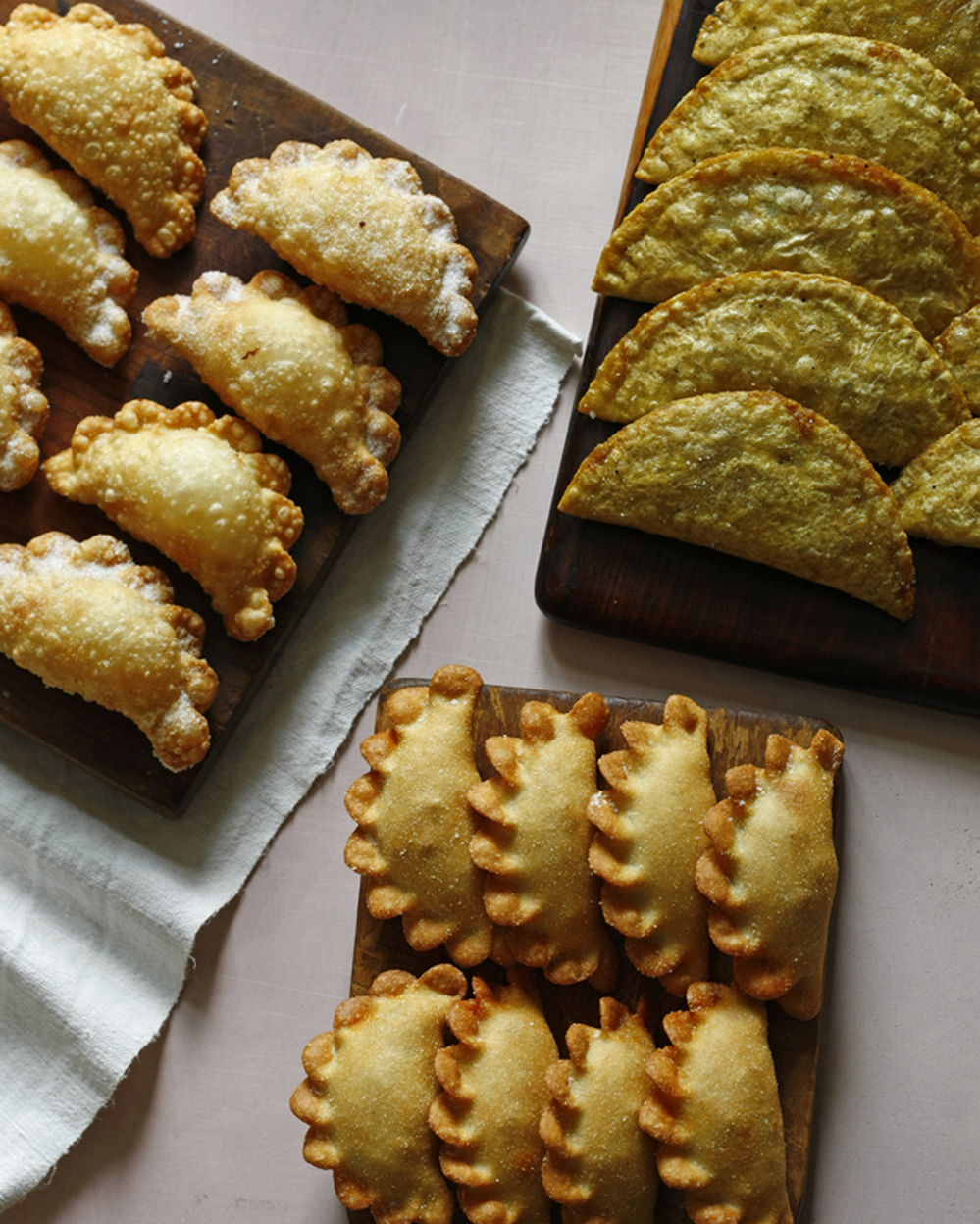
For chef and restauranteur Jose Garces, watching football on television as a boy also meant snacking on his mother's homemade empanadas.
For chef and restauranteur Jose Garces, watching football on television as a boy also meant snacking on his mother's homemade empanadas.

For chef and restauranteur Jose Garces, watching football on television as a boy also meant snacking on his mother's homemade empanadas.

Say "Super Bowl" to Philadelphia chef and restaurateur Jose Garces, and he instantly recalls winter Sundays growing up in Chicago. "While my dad and two brothers and I were watching a Bears football game, empanadas would just appear in front of my lap," he tells All Things Considered host Melissa Block.

Every Latin American country boasts their own empanadas baked or fried pockets of dough stuffed with cheese, meat or some other filling. The empanadas Garces ate as a child reflected his family's Ecuadorian roots.

The chef has shared two empanada recipes with NPR: his mother's Empanadas de Viento, made with Queso Fresco, and his grandmother's Empanadas de Verde con Pollo, found below.


Recipe: Empanadas de Verde con Pollo
(Green Plantain Empanadas with Braised Chicken)

Makes 12 empanadas

The plantains must be squeezed through a ricer twice to create a smooth dough and develop the starches. The small dough rounds can be refrigerated for a few hours if covered tightly with plastic wrap; same goes for the formed empanadas. But don't push the timing the dough will begin to dry out and crack after 3 hours. Any leftover chicken filling is excellent in tacos or on a salad.

Dough

2 Green plantains (about 1 pound)
Kosher salt

Chicken Filling

2 tablespoons unsalted butter
1 tablespoon extra virgin olive oil
1/4 pound boneless, skinless chicken thighs, coarsely cut into 1/2-inch pieces
1/4 pound boneless, skinless chicken breast, coarsely cut into 1/2-inch pieces
1/2 Spanish onion, diced small
1 tablespoon minced garlic (3 to 4 cloves)
1 teaspoon Spanish smoked sweet paprika
1 tablespoon achiote paste
2 tablespoons tomato paste
1 teaspoon whole cumin seeds, toasted and ground
1 cup chicken stock
1 small Yukon gold potato, peeled, diced small, and blanched
1/2 pound fresh English peas, shelled and blanched
1/4 cup minced fresh cilantro
2 tablespoons minced fresh flat-leaf parsley
2 scallions (white and green parts), minced

Kosher salt and freshly ground black pepper
1 1/2 qts vegetable oil, for frying
Aji costeno, for serving

To peel the plantains, split the skins lengthwise with a sharp knife and soak in warm water until the skins are easily removed, about 30 minutes.

To make the dough, bring a large saucepan of lightly salted water to a boil and cook the plantains until they are soft, about 30 minutes. Remove from the heat and allow the plantains to rest in the water until they are cool to the touch.

Pass the cooked plantains through a ricer into a bowl. Rice the plantains a second time. Knead the resulting dough until it is very smooth, about 5 minutes. Allow the dough to rest at room temperature, covered with a damp towel, for 1 hour before making the empanadas.

To make the filling, heat the butter and olive oil in a cast-iron skillet over medium-high heat. Add the chicken, onion and garlic and cook until lightly browned, 8 to 10 minutes. Add the paprika, achiote paste, tomato paste, and cumin and cook for 2 to 3 minutes more. Add the stock, potato, peas, cilantro, parsley and scallions and season to taste with salt and pepper. Let the mixture cool to room temperature. Lift out the chicken meat, shred it and mix it back into the filling.

To assemble the empanadas, divide the dough into a dozen 1-inch balls. Using a manual tortilla press, a rolling pin or the heel of your hand, press each dough ball into a circle about 6 inches in diameter. Mound 2 tablespoons of the filling in the center of each round and fold over to form a half-moon shape. Use a dinner fork to crimp the outer edge. Alternatively, use a plastic empanada press from a Latin market.

To cook the empanadas, heat the vegetable oil to 350 degrees in a stockpot, using a candy or deep-fry thermometer to monitor the temperature. Line a baking sheet with parchment paper.

Fry the empanadas in batches until golden brown and crispy, 3 to 4 minutes each, turning once in the oil. Drain them on the baking sheet. Season to taste with salt before serving with aji.

Recipe from The Latin Road Home by Jose Garces. Copyright 2012 by Jose Garces. Excerpted by permission of Lake Isle Press.


NUTRI-BLAST.COM Philadelphia Personal Trainer BodyBlast Personal Training Blog www.nutri-blast.com Best New Places To Eat, Drink And Shop In Thrillist Nation - Thrillist Find the best spots to eat, drink and shop at some of the hippest stores across America. Thrillist unearths all that's new, unknown or under-appreciated. Growing Your Baby Parenthood from Pregnancy to Pre-school ... Parents of Overweight Children Have a New, Serious Health Complication to be Concerned About CNN.com - Breaking News, U.S., World, Weather, Entertainment ... CNN.com delivers the latest breaking news and information on the latest top stories, weather, business, entertainment, politics, and more. For in-depth coverage, CNN ... Adweek Breaking News in Advertising, Media and Technology It's Game On for Second Screen While CBS secures separate ad deals for Super Bowl live stream, NFL and Verizon intercepts with big smartphone play Football Fanatics - Sports Apparel, NFL, Fan Shop, Jerseys ... Shop Football Fanatics for sports apparel and fan merchandise! Our ultimate sports store features NFL Apparel, Sportswear and Gifts for every team. Get College ... Recipes - How To Information eHow.com Recipes: Wondering whats for breakfast, lunch, or dinner? Need a side dish or appetizer to serve with your favorite recipe? Find healthy recipes, cooking tips and ... Sports - How To Information eHow.com Sports: Need golf tips to improve your game? Watch how to videos on golf drills, football spirals, and perfect ballet plies on eHow. Get essential tips on baseball ...

Thursday, November 15, 2012

A Dash Of Latin Flavor On The Thanksgiving Table

Chef Jose Garces Enlarge image

Chef Jose Garces

Chef Jose Garces

Chef Jose Garces

When Chef Jose Garces, the Philadelphia-based restaurateur and author of The Latin Road Home, thinks back to the Thanksgiving table of his youth, he remembers the turkey, and his father's chicken giblet gravy.

But his parents, who emigrated to Chicago from Ecuador in the 1960s, whipped up Ecuadorean staples as well.

Those might be meat-filled empanadas, or sweet corn humitas Ecuadorean tamales.

"[Humita] is basically a puree of yellow corn, with white corn flour. It's filled with scallions and cheese, and then it's wrapped in a rehydrated corn husk and steamed," says Garces. "It has a little bit of baking powder so it kind of fluffs up. It should be nice and airy. It's something we would serve for Thanksgiving in place of corn bread."

Humitas can be stuffed with chicken or beef.

"Any good Ecuadorean would tell you it's sacrilege not to serve them just with cheese," says Garces.

Chef Jose Garces' quinoa soup.

Chef Jose Garces' quinoa soup.

Garces says his family also enjoyed a quinoa soup a chowder in the locro family, made with Ecuadorean potatoes and milk. His family's version has aromatic vegetables, cooked quinoa, achiote or annatto paste, fresh corn kernels and a touch of cream. He tops it off with bacon bits or lardon.

And to drink?

"In the season it gets a little chilly, and we really like sangria as a family," says Garces. "It's just a great festive cocktail."

And it is possible to make it nonalcoholic as well, Garces says.

Click on the links below for Garces' recipes:

Sweet corn humitas

Quinoa soup

Sangria

And for more of his recipes, check out this recent interview on Talk of the Nation.


Snooth: Top 10 Wines for Your Thanksgiving Table The wine you like is the best wine for your Thanksgiving but, in case you are searching through all the options, I thought this would be a good time break ... Salt Free Seasonings Mrs. Dash Join Mrs.Dash. What!? Not part of the My Mrs. Dash Community? Youre missing out! Join to enjoy: New recipes and cooking tips from Mrs. Dash Flavors of the Sun Pulled Barbecue Chicken Sandwiches on Sweet Potato Biscuits and Mini Mac 'n' Cheese Bites Hearts of Palm Ceviche Tostadas The Latin Kitchen Serve these ceviche appetizers with Chipotle Cream to add a creamy, spicy component to really make the flavors shine. Sausage - Wikipedia, the free encyclopedia A sausage is a food usually made from ground meat with a skin around it. Typically, a sausage is formed in a casing traditionally made from intestine, but sometimes ... Articles Relish Thanksgiving Dinner: Talkin Turkey (VIDEO) Join Chef Brian Morris, with son Jack as co-chef and narrator, as he demystifies all things turkey with seven short how ... Casual Dinnerware Sets, Table Settings & Place Settings Pottery Barn Shop Pottery Barn for a huge selection of casual dinnerware and table settings. Find casual dinnerware sets and place settings in unique styles and finishes. Homemade Tortilla Chips Recipes - Latin Food and Recipes Latin ... Homemade Tortilla Chips from spicy to sweet ... Try serving up this Puebla style mole sauce on your turkey this Thanksgiving. Beef Turnovers. Rissis de Carne The New Portuguese Table ... Colman Andrews is living the life most culinarians would be envious of. Travelling the globe, enjoying great regional food and wine, and getting to write about it in ... Liz Johnson - Small Bites Food Finds in the Lower Hudson Valley Food Finds in the Lower Hudson Valley ... Hey Hey! A pleasure to meet you all, Im Christina Halpin and I couldnt be more thrilled to participate in Hudson ...

Friday, October 5, 2012

Chef Jose Garces Follows His 'Latin Road Home'

Chef Jose Garces published his first cookbook, Latin Evolution, in 2008.

Chef Jose Garces published his first cookbook, Latin Evolution, in 2008.

Chef Jose Garces published his first cookbook, Latin Evolution, in 2008.

text size A A A
October 4, 2012

Jose Garces is among the most talented and innovative chefs in America. He opened his first restaurant, Amada, in 2005, and since then his Garces Group has opened 14 other restaurants across the country.

In 2009, he won the James Beard Award for Best Chef in the Mid-Atlantic region, and he's also a Food Network Iron Chef, rubbing elbows with the likes of Bobby Flay, Cat Cora and Michael Symon.

Now Chef Garces has a new book, The Latin Road Home. Part cookbook, part memoir and part travelogue, it traces the food traditions that have influenced his cooking. From Spain to Mexico, to Ecuador, Peru and Cuba, he investigated the techniques and ingredients that shaped the foods of his childhood.

Garces talks with NPR's Lynn Neary about his journey, and shares some favorite recipes.


Interview Highlights

On the food from his home country, Ecuador

"It's not a popular, I would say, mainstream cuisine here in the U.S. It's something that, I think, still needs to be discovered, and it's a very flavorful cuisine. ... Some of the best cooks that I've cooked with, whether it's in New York or Chicago or even here in Philadelphia, are actually Ecuadorians. And there's something about their palates that really just inspires me, and has a really deep sense of flavor. ...

The Latin Road Home

The Latin Road Home

Savoring the Foods of Ecuador, Spain, Cuba, Mexico and Peru

by Jose Garces

Hardcover, 304 pages purchase

close

Purchase Featured Books

  • The Latin Road Home
  • Savoring the Foods of Ecuador, Spain, Cuba, Mexico and Peru
  • Jose Garces
  • Amazon
  • Independent Booksellers
  • Nonfiction
  • Food & Wine

More on this book:

  • NPR reviews, interviews and more

"In The Latin Road Home, I talk about this kind of peasant style that's called las cosas finas, along with fritada. So fritada is a fried, crispy pork, and las cosas finas translates into 'the finer things,' or 'fine things.' And what it really is is a corn and hominy salad with fried pork. So that would be something that I could remember when I was 7 years old. I would see these ladies drive around these large carts and scream, 'Mote, mote!' And that would just mean that there is this hominy salad with crispy pork, and that would be, I would say, an Ecuadorian staple."

On the best ways to cook beans

"Beans are a staple, and my wife is Cuban. So I have to partake in my weekly dosage of Cuban beans, whether they're red or black or pinto. I mean, you name it. And, you know, one thing that's in beans, I think, having some ham product, whether it's bacon or a smoked ham hock, good aromatics and just giving them their time to cook. A good soak always works as well. So, soaking the beans overnight and then cooking them with enough liquid and just letting them go slow and low works. ...

"Probably for, like, one cup of beans, you would have about six cups of water. ... And then, you know, if they start to dry, just add more. And as they break down, they start to release some of their starch, and it begins to really make a flavorful broth, as well."

On the best places to eat in Cuba

"One of the things that I hope to do with The Latin Road Home is transport people to these different countries. So you open the chapter in Cuba, I'm taking you to a paladar, which is a restaurant in somebody's home in Cuba. And I'm sharing with you a meal that I experienced in a different paladar. ...

"I found that the restaurants weren't as great in Havana as the paladars were, which were little tables inside somebody's home. So it might only be like two or three tables, but folks were cooking their home-cooked meals, and that's where you would have dinner."


Recipe: Chilango Huarache
(Huarache with Chorizo, Carnitas and Serrano Ham)

Note that the masa cakes can be partially cooked, then wrapped in plastic and refrigerated for up to 2 days. Makes 4 servings.

Huarache de Carnitas (Corn Flatbread with Pulled Pork)

Masa Cakes

1/2 cup Maseca brand white corn instant masa harina
1/4 teaspoon chile de rbol powder
1/2 teaspoon kosher salt
1/3 cup warm water

Toppings

1 large potato (about 1/2 pound), boiled in salted water, peeled and mashed until smooth
1/2 cup crumbled Mexican chorizo (about 1/4 pound), cooked until lightly browned and drained
1 cup carnitas
4 ounces Oaxaca cheese, shredded (about 1 cup)
16 slices Serrano ham (about 1/3 pound)
2 tablespoons pickled jalapenos, drained
Microgreens, for garnish
Bottled Mexican hot sauce

To make the masa cakes, combine the masa harina, chili powder and salt in a large mixing bowl. Slowly add the warm water, using your hands to mix the dough until smooth and form it into a ball. Cover the dough with a damp cloth and allow it to rest for 20 minutes.

Heat a lightly oiled griddle or skillet over medium heat.

Divide the dough into four equal portions. Use a rolling pin or tortilla press to flatten each portion, between two sheets of plastic wrap, into a long oval 1/16- to 1/8-inch thick. Precook each masa cake on the griddle for 2 minutes per side. If not using right away, wrap the masa cakes in plastic wrap and refrigerate until needed, up to 3 days.

Place a baking stone in the oven and preheat the oven and stone to 450 degrees for 1 hour.

To top the masa cakes, spread each with a thin layer of potato, then top evenly with the chorizo, carnitas and Oaxaca cheese. Bake the huaraches directly on the baking stone until the bottoms of the cakes are crispy and the cheese is melted, 6 to 8 minutes. Top each huarache with 4 slices ham and sprinkle on a few slices of pickled jalapeno and microgreens. Pass hot sauce at the table.


Recipe: Ropa Vieja con Frijoles Colorados
(Braised Shredded Beef Stew with Red Beans)

Here, again, the pressure cooker is an absolute necessity: It expedites the cooking and makes the meat tender and the whole dish deeply flavorful. Makes 4 servings.

Ensalada de Palmito (Hearts of Palm Salad)Ropa Vieja con Arroz (Cuban-Style Braised & Shredded Beef with Rice)Frijoles Colorados (Cuban Red Beans)

Braised Beef

2 tablespoons vegetable oil + 2 tablespoons
2 pounds boneless beef short ribs
Kosher salt and freshly ground black pepper
1/4 pound thick-cut bacon, diced small
1 large Spanish onion, diced small
1 red bell pepper, diced small
1 green bell pepper, diced small
2 tablespoons minced garlic (4 to 6 cloves)
2 tablespoons roasted garlic (4 to 6 cloves)
1/4 cup tomato paste
2 tablespoons whole cumin seeds, toasted and ground
2 tablespoons cider vinegar
2 quarts beef stock
1/2 pound dried red kidney beans, soaked overnight, drained, and rinsed (2 cups)

Sauce

2 tablespoons vegetable oil
1 large Spanish onion, thinly sliced
1 large green bell pepper, thinly sliced
1 large red bell pepper, thinly sliced
2 tablespoons minced garlic (4 to 6 cloves)
1/4 cup tomato paste
2 Tbsp chopped fresh parsley
2 Tbsp chopped fresh cilantro
5 plum tomatoes, seeded and diced small
Kosher salt and freshly ground black pepper

To Serve

White Rice
Fried sweet plantains
2 scallions (white and green parts), thinly sliced on the diagonal

To prepare the braised beef, heat 2 tablespoons of the oil in a large cast-iron skillet over medium-high heat. Generously season the meat with salt and pepper. Sear it until well browned, 3 to 4 minutes per side. Set aside.

Heat the remaining 2 tablespoons oil in a pressure cooker over medium-high heat until it shimmers. Add the bacon, onion, bell peppers and raw and roasted garlic. Cook until the onion is translucent, about 10 minutes, stirring frequently. Stir in the tomato paste, cumin and vinegar and cook until the mixture is lightly caramelized, about 5 minutes. Add the stock, seared short ribs and kidney beans. Close and seal the pressure cooker and cook over medium-high heat for 1 hour.

Prepare an ice bath in the kitchen sink. Transfer the still-sealed pressure cooker to the ice bath and leave it to cool for 5 minutes. Lift the pressure cooker out of the ice bath, carefully unseal it and remove the lid.

Lift the short ribs out of the cooker; the meat should be soft to the touch and fork-tender. While the meat is still hot, shred it with a fork and set aside. Measure out 1 quart (4 cups) of the braising liquid and set aside (return any beans to the pot).

To finish the beans, transfer the contents of pressure cooker to a saucepan and cook over medium heat, stirring occasionally, until the liquid thickens, 18 to 20 minutes.

Meanwhile, to make the sauce, heat the oil in a large saute pan over medium-high heat. Add the onion, bell peppers and garlic and cook until translucent, about 10 minutes, stirring frequently. Stir in the tomato paste and cook until the mixture is caramelized, about 5 minutes. Add the reserved braising liquid and cook until reduced by about half, about 15 minutes. Add the meat and stir to incorporate. Fold in the parsley, cilantro and tomatoes and season to taste with salt and pepper.

Serve the ropa vieja and beans with rice and plantains, garnished with scallions.


Recipe: Empanadas de Viento
(Empanadas with Queso Fresco)

The dough must rest properly and has to be rolled out thinly to be workable, but once you get it down, this is an easy dough to handle. When forming the empanadas, make sure the edges are well sealed so they don't leak while frying. You can roll and crimp the edges a few times to help ensure that they're closed up tightly. Fully formed empanadas de viento can be frozen, wrapped tightly in plastic and foil, for up to 2 months; thaw in the refrigerator before frying. The dough can be refrigerated for up to 1 day. Makes 12 empanadas.

Empanadas

Dough

2 cups all-purpose flour, sifted
1 teaspoon kosher salt
2 tablespoons granulated sugar
1/2 cup vegetable shortening
1 large egg yolk
1/2 cup cold water

Empanadas

1/4 pound queso fresco, grated (2 cups)
2 quarts vegetable oil, for frying
1/4 cup granulated sugar, for sprinkling

Pickled onions, for serving

Aji costeno, for serving

To make the dough, sift the flour, salt and sugar together in a bowl. Use a pastry blender to cut the vegetable shortening into the dry ingredients until it is fully incorporated. Add the egg yolk and mix well. Adding 2 or 3 tablespoons at a time, knead in the water with your hands until a smooth dough forms. Pat the dough into a round, flat disk and wrap it tightly in plastic wrap. Refrigerate it for at least 1 hour or up to 1 day before making the empanadas. To assemble the empanadas, divide the chilled dough into a dozen 1-inch balls. Using a manual tortilla press, a rolling pin or the heel of your hand, press each dough ball into a circle about 1/8-inch thick and about 6 inches in diameter.

Mound about 2 tablespoons of cheese in the center of each round and fold the dough over to form a half-moon. Use a dinner fork to crimp the outer edge. Alternatively, use a plastic empanada press from a Latin market. To cook the empanadas, heat the oil to 350 degrees in a stockpot, using a candy or deep-fry thermometer to monitor the temperature. Line a baking sheet with parchment paper. Fry the empanadas in batches until they are golden brown and crispy, 3 to 4 minutes each, turning once in the oil. Drain them on the baking sheet and sprinkle with sugar before serving with pickled onions and aji on the side.

All recipes from The Latin Road Home by Jose Garces. Copyright 2012 by Jose Garces. Excerpted by permission of Lake Isle Press.


Chef Jose Garces Follows His 'Latin Road Home'

Chef Jose Garces published his first cookbook, Latin Evolution, in 2008.

Chef Jose Garces published his first cookbook, Latin Evolution, in 2008.

Chef Jose Garces published his first cookbook, Latin Evolution, in 2008.

text size A A A
October 4, 2012

Jose Garces is among the most talented and innovative chefs in America. He opened his first restaurant, Amada, in 2005, and since then his Garces Group has opened 14 other restaurants across the country.

In 2009, he won the James Beard Award for Best Chef in the Mid-Atlantic region, and he's also a Food Network Iron Chef, rubbing elbows with the likes of Bobby Flay, Cat Cora and Michael Symon.

Now Chef Garces has a new book, The Latin Road Home. Part cookbook, part memoir and part travelogue, it traces the food traditions that have influenced his cooking. From Spain to Mexico, to Ecuador, Peru and Cuba, he investigated the techniques and ingredients that shaped the foods of his childhood.

Garces talks with NPR's Lynn Neary about his journey, and shares some favorite recipes.


Interview Highlights

On the food from his home country, Ecuador

"It's not a popular, I would say, mainstream cuisine here in the U.S. It's something that, I think, still needs to be discovered, and it's a very flavorful cuisine. ... Some of the best cooks that I've cooked with, whether it's in New York or Chicago or even here in Philadelphia, are actually Ecuadorians. And there's something about their palates that really just inspires me, and has a really deep sense of flavor. ...

The Latin Road Home

The Latin Road Home

Savoring the Foods of Ecuador, Spain, Cuba, Mexico and Peru

by Jose Garces

Hardcover, 304 pages purchase

close

Purchase Featured Books

  • The Latin Road Home
  • Savoring the Foods of Ecuador, Spain, Cuba, Mexico and Peru
  • Jose Garces
  • Amazon
  • Independent Booksellers
  • Nonfiction
  • Food & Wine

More on this book:

  • NPR reviews, interviews and more

"In The Latin Road Home, I talk about this kind of peasant style that's called las cosas finas, along with fritada. So fritada is a fried, crispy pork, and las cosas finas translates into 'the finer things,' or 'fine things.' And what it really is is a corn and hominy salad with fried pork. So that would be something that I could remember when I was 7 years old. I would see these ladies drive around these large carts and scream, 'Mote, mote!' And that would just mean that there is this hominy salad with crispy pork, and that would be, I would say, an Ecuadorian staple."

On the best ways to cook beans

"Beans are a staple, and my wife is Cuban. So I have to partake in my weekly dosage of Cuban beans, whether they're red or black or pinto. I mean, you name it. And, you know, one thing that's in beans, I think, having some ham product, whether it's bacon or a smoked ham hock, good aromatics and just giving them their time to cook. A good soak always works as well. So, soaking the beans overnight and then cooking them with enough liquid and just letting them go slow and low works. ...

"Probably for, like, one cup of beans, you would have about six cups of water. ... And then, you know, if they start to dry, just add more. And as they break down, they start to release some of their starch, and it begins to really make a flavorful broth, as well."

On the best places to eat in Cuba

"One of the things that I hope to do with The Latin Road Home is transport people to these different countries. So you open the chapter in Cuba, I'm taking you to a paladar, which is a restaurant in somebody's home in Cuba. And I'm sharing with you a meal that I experienced in a different paladar. ...

"I found that the restaurants weren't as great in Havana as the paladars were, which were little tables inside somebody's home. So it might only be like two or three tables, but folks were cooking their home-cooked meals, and that's where you would have dinner."


Recipe: Chilango Huarache
(Huarache with Chorizo, Carnitas and Serrano Ham)

Note that the masa cakes can be partially cooked, then wrapped in plastic and refrigerated for up to 2 days. Makes 4 servings.

Huarache de Carnitas (Corn Flatbread with Pulled Pork)

Masa Cakes

1/2 cup Maseca brand white corn instant masa harina
1/4 teaspoon chile de rbol powder
1/2 teaspoon kosher salt
1/3 cup warm water

Toppings

1 large potato (about 1/2 pound), boiled in salted water, peeled and mashed until smooth
1/2 cup crumbled Mexican chorizo (about 1/4 pound), cooked until lightly browned and drained
1 cup carnitas
4 ounces Oaxaca cheese, shredded (about 1 cup)
16 slices Serrano ham (about 1/3 pound)
2 tablespoons pickled jalapenos, drained
Microgreens, for garnish
Bottled Mexican hot sauce

To make the masa cakes, combine the masa harina, chili powder and salt in a large mixing bowl. Slowly add the warm water, using your hands to mix the dough until smooth and form it into a ball. Cover the dough with a damp cloth and allow it to rest for 20 minutes.

Heat a lightly oiled griddle or skillet over medium heat.

Divide the dough into four equal portions. Use a rolling pin or tortilla press to flatten each portion, between two sheets of plastic wrap, into a long oval 1/16- to 1/8-inch thick. Precook each masa cake on the griddle for 2 minutes per side. If not using right away, wrap the masa cakes in plastic wrap and refrigerate until needed, up to 3 days.

Place a baking stone in the oven and preheat the oven and stone to 450 degrees for 1 hour.

To top the masa cakes, spread each with a thin layer of potato, then top evenly with the chorizo, carnitas and Oaxaca cheese. Bake the huaraches directly on the baking stone until the bottoms of the cakes are crispy and the cheese is melted, 6 to 8 minutes. Top each huarache with 4 slices ham and sprinkle on a few slices of pickled jalapeno and microgreens. Pass hot sauce at the table.


Recipe: Ropa Vieja con Frijoles Colorados
(Braised Shredded Beef Stew with Red Beans)

Here, again, the pressure cooker is an absolute necessity: It expedites the cooking and makes the meat tender and the whole dish deeply flavorful. Makes 4 servings.

Ensalada de Palmito (Hearts of Palm Salad)Ropa Vieja con Arroz (Cuban-Style Braised & Shredded Beef with Rice)Frijoles Colorados (Cuban Red Beans)

Braised Beef

2 tablespoons vegetable oil + 2 tablespoons
2 pounds boneless beef short ribs
Kosher salt and freshly ground black pepper
1/4 pound thick-cut bacon, diced small
1 large Spanish onion, diced small
1 red bell pepper, diced small
1 green bell pepper, diced small
2 tablespoons minced garlic (4 to 6 cloves)
2 tablespoons roasted garlic (4 to 6 cloves)
1/4 cup tomato paste
2 tablespoons whole cumin seeds, toasted and ground
2 tablespoons cider vinegar
2 quarts beef stock
1/2 pound dried red kidney beans, soaked overnight, drained, and rinsed (2 cups)

Sauce

2 tablespoons vegetable oil
1 large Spanish onion, thinly sliced
1 large green bell pepper, thinly sliced
1 large red bell pepper, thinly sliced
2 tablespoons minced garlic (4 to 6 cloves)
1/4 cup tomato paste
2 Tbsp chopped fresh parsley
2 Tbsp chopped fresh cilantro
5 plum tomatoes, seeded and diced small
Kosher salt and freshly ground black pepper

To Serve

White Rice
Fried sweet plantains
2 scallions (white and green parts), thinly sliced on the diagonal

To prepare the braised beef, heat 2 tablespoons of the oil in a large cast-iron skillet over medium-high heat. Generously season the meat with salt and pepper. Sear it until well browned, 3 to 4 minutes per side. Set aside.

Heat the remaining 2 tablespoons oil in a pressure cooker over medium-high heat until it shimmers. Add the bacon, onion, bell peppers and raw and roasted garlic. Cook until the onion is translucent, about 10 minutes, stirring frequently. Stir in the tomato paste, cumin and vinegar and cook until the mixture is lightly caramelized, about 5 minutes. Add the stock, seared short ribs and kidney beans. Close and seal the pressure cooker and cook over medium-high heat for 1 hour.

Prepare an ice bath in the kitchen sink. Transfer the still-sealed pressure cooker to the ice bath and leave it to cool for 5 minutes. Lift the pressure cooker out of the ice bath, carefully unseal it and remove the lid.

Lift the short ribs out of the cooker; the meat should be soft to the touch and fork-tender. While the meat is still hot, shred it with a fork and set aside. Measure out 1 quart (4 cups) of the braising liquid and set aside (return any beans to the pot).

To finish the beans, transfer the contents of pressure cooker to a saucepan and cook over medium heat, stirring occasionally, until the liquid thickens, 18 to 20 minutes.

Meanwhile, to make the sauce, heat the oil in a large saute pan over medium-high heat. Add the onion, bell peppers and garlic and cook until translucent, about 10 minutes, stirring frequently. Stir in the tomato paste and cook until the mixture is caramelized, about 5 minutes. Add the reserved braising liquid and cook until reduced by about half, about 15 minutes. Add the meat and stir to incorporate. Fold in the parsley, cilantro and tomatoes and season to taste with salt and pepper.

Serve the ropa vieja and beans with rice and plantains, garnished with scallions.


Recipe: Empanadas de Viento
(Empanadas with Queso Fresco)

The dough must rest properly and has to be rolled out thinly to be workable, but once you get it down, this is an easy dough to handle. When forming the empanadas, make sure the edges are well sealed so they don't leak while frying. You can roll and crimp the edges a few times to help ensure that they're closed up tightly. Fully formed empanadas de viento can be frozen, wrapped tightly in plastic and foil, for up to 2 months; thaw in the refrigerator before frying. The dough can be refrigerated for up to 1 day. Makes 12 empanadas.

Empanadas

Dough

2 cups all-purpose flour, sifted
1 teaspoon kosher salt
2 tablespoons granulated sugar
1/2 cup vegetable shortening
1 large egg yolk
1/2 cup cold water

Empanadas

1/4 pound queso fresco, grated (2 cups)
2 quarts vegetable oil, for frying
1/4 cup granulated sugar, for sprinkling

Pickled onions, for serving

Aji costeno, for serving

To make the dough, sift the flour, salt and sugar together in a bowl. Use a pastry blender to cut the vegetable shortening into the dry ingredients until it is fully incorporated. Add the egg yolk and mix well. Adding 2 or 3 tablespoons at a time, knead in the water with your hands until a smooth dough forms. Pat the dough into a round, flat disk and wrap it tightly in plastic wrap. Refrigerate it for at least 1 hour or up to 1 day before making the empanadas. To assemble the empanadas, divide the chilled dough into a dozen 1-inch balls. Using a manual tortilla press, a rolling pin or the heel of your hand, press each dough ball into a circle about 1/8-inch thick and about 6 inches in diameter.

Mound about 2 tablespoons of cheese in the center of each round and fold the dough over to form a half-moon. Use a dinner fork to crimp the outer edge. Alternatively, use a plastic empanada press from a Latin market. To cook the empanadas, heat the oil to 350 degrees in a stockpot, using a candy or deep-fry thermometer to monitor the temperature. Line a baking sheet with parchment paper. Fry the empanadas in batches until they are golden brown and crispy, 3 to 4 minutes each, turning once in the oil. Drain them on the baking sheet and sprinkle with sugar before serving with pickled onions and aji on the side.

All recipes from The Latin Road Home by Jose Garces. Copyright 2012 by Jose Garces. Excerpted by permission of Lake Isle Press.