Showing posts with label Harvard School of Public Health. Show all posts

Monday, March 4, 2013

Selling Kids On Veggies When Rules Like 'Clean Your Plate' Fail

Experts say that positive encouragements work better than dinnertime rules like "no second helpings" to get kids to eat some foods.

If you're a parent, you've probably heard remarks like this during dinner: "I don't like milk! My toast is burnt! I hate vegetables! I took a bite already! What's for dessert?" It can be daunting trying to ensure a healthy diet for our children. So it's no wonder parents often resort to dinner time rules.

In our new poll, with the Robert Wood Johnson Foundation and the Harvard School of Public Health, 25 percent of families tell their children to eat everything on their plate, and 45 percent report setting restrictions on the types of foods eaten. Increasingly common are rules like "clean your plate," as well as newer strictures such as "no second helpings of potatoes," "no dessert until you eat your vegetables" and "sodas and chips only on special occasions."

This is all well-meant advice. But does it work? Kelly Brownell, who directs the Rudd Center for Food Policy & Obesity at Yale University, says "No."

"By demanding that children eat things like vegetables before they have a dessert, it makes it seem like there's something wrong with eating vegetables, and that you have to swallow medicine before you get to the good part," Brownell says.

Not only that, rules like this can backfire, according to Kristi King, a registered dietitian at Texas Children's Hospital and a spokesperson with the Academy of Nutrition and Dietetics. "Some of the studies have shown us that when they were put in a situation where somebody is saying 'finish this,' or 'finish that,' the kids actually had more negative responses and actually consumed less of the food than the kids who didn't have that reinforcement of 'You need to finish.'"

The better option, King says, is creative negotiation. Take, for example, what she calls "Try It Tuesdays." On a "Try it Tuesday," parents, along with their children, pick out a new food to sample. It helps to involve the kids in preparing the dish as well, she says. This investment in the new food increases the likelihood the child will try it and even enjoy it.

If they still say no, King suggests "no thank you bites" something her friends made up for their 3-year-old daughter. It goes like this: The child just has to take a bite, and if they don't like it, they can say "no thank you," and that's that. But typically in this family, the "no thank you" turns into a "thank you," as the 3-year-old watches her parents eating and enjoying the food.

"You see her little hand reach across to the fork, and it kind of goes over into the vegetable," King says. "The next thing you know, you turn around and she's eaten the entire vegetable."

And, it turns out as with most other behaviors your kids are watching you, King says. "I had a parent who came into clinic not too long ago, and I said, 'OK, what's our goal for being here today?' And he looked at me and said, 'Make him eat vegetables!' And, my question back was, 'Well, do you eat vegetables?' And his answer was, 'No, I don't like them.'"

Dad mentioned he loved grilling, so King suggested he try that with vegetables. By their next visit, he'd become an avid veggie griller.

"Zucchini and squash and carrots and eggplants and onions and tomatoes you name it, he was grilling it," says King. "[It's] a dietitian's dream getting an entire family involved in eating more healthy foods."

As for dessert, Yale University's Brownell says there's nothing wrong with an occasional treat. "That doesn't mean that the only options are things high in sugar or fat or salt. There can be wonderful combinations of things like sorbet, sherbet, fruits things like that can make outstanding desserts and be really good for people."

Some parents worry that having only healthy foods at home will lead kids to overdo it with junk food when they head off to college. But Brownell says there's no evidence to support this worry. And, in fact, the reverse is probably true.

Even if the young adults indulge in unhealthy foods at first, they're far more likely to return to the healthy foods they grew up with. "Having only good foods around the house makes all the sense in the world, and research supports this," he says.

So, Brownell says, fill your kitchen with healthy food, don't buy junk food and watch what you eat. Your kids will follow your lead.

This story is part of the series On the Run: How Families Struggle to Eat Well and Exercise. The series is based on a poll from NPR, the Robert Wood Johnson Foundation and the Harvard School of Public Health. If you want to dive deeper, here's a summary of the poll findings, plus the topline data and charts.


Friday, March 1, 2013

How Did Our Brains Evolve To Equate Food With Love?

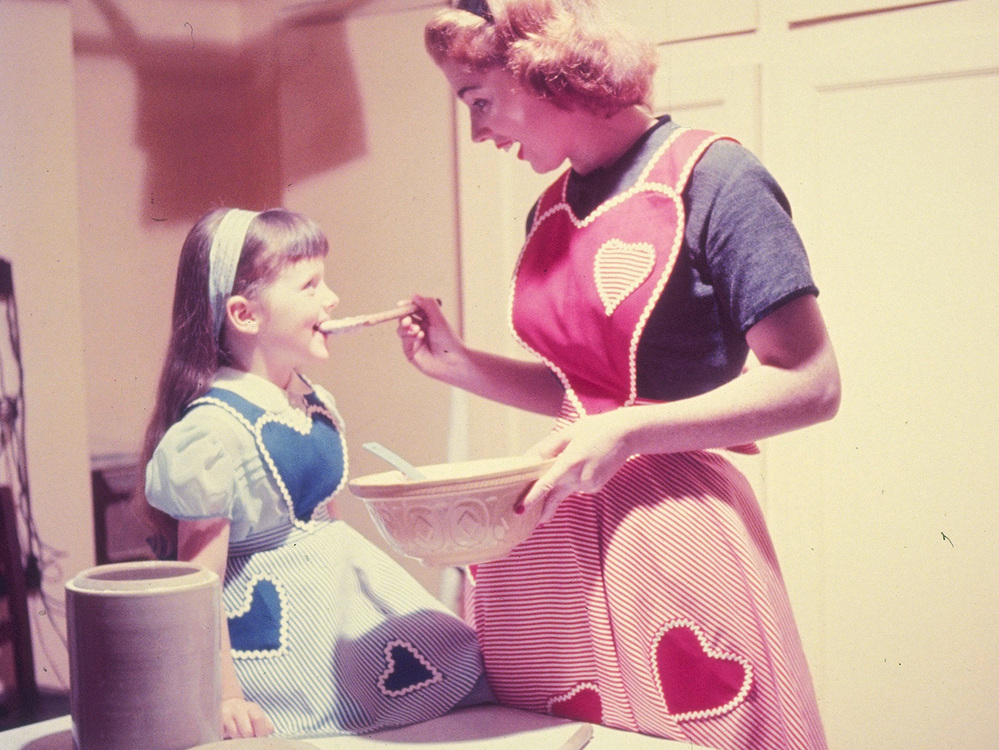
At some point in human evolution, our brains became wired to remember food events and the people associated with them. Enlarge image i

At some point in human evolution, our brains became wired to remember food events and the people associated with them.

At some point in human evolution, our brains became wired to remember food events and the people associated with them.

At some point in human evolution, our brains became wired to remember food events and the people associated with them.

If food is love, Americans must love their kids a lot. About one-third of children and adolescents in the U.S. are overweight or obese.

And our emotional response to food may be one of the reasons so many kids eat so much, according to a poll by NPR, the Robert Wood Johnson Foundation and the Harvard School of Public Health. The poll found that in more than a quarter of families, food is considered an important way to show affection.

That result is no surprise to Carol Cassie, who lives in Great Falls, Mont. For many years she ran a restaurant there called Mama Cassie's, where the front of each menu proclaimed, "Food is love."

"I wanted my customers to know as soon as they came into the restaurant that I was caring for them," says Cassie, who is also the author of Mama Cassie's "Food is Love!" Cookbook.

Customers at the restaurant really did feel like family, says Erin Duffy Osswald, who used to work at the restaurant and edited the cookbook.

"People would get engaged at Mama Cassie's," Osswald says. "They would satisfy their pregnancy cravings on turtle cake from Mama Cassie's. They would bring their babies into Mama Cassie's later, and Carol would walk around the restaurant with them."

Cassie says she loved running the restaurant. But looking back, she says, there's something that concerns her. Some of her customers, including whole families, didn't seem to know when to stop.

"They'll have big plates of whatever, like a big pork sandwich that was just oozing with cheese and pulled pork and the meat sauce," Cassie says. And then, "they would have a piece of cheesecake afterward."

Just plain gluttony? Or did customers at Mama Cassie's think more food meant more love?

Love is probably at least part of the answer, scientists say, because of the way humans have evolved.

You can see some aspects of human food behavior in our animal ancestors, including marmoset and tamarin monkeys. These monkeys are like people in that fathers and siblings help raise the offspring, and all the adults make a big deal of providing food to youngsters in the family, says Adrian Jaeggi, a biological anthropologist at the University of California, Santa Barbara.

The older monkeys give a special call when they find a special treat, like insects that are "big and juicy and very nutritious," Jaeggi says. Then they adopt the "food offering posture" to present the young monkeys with the treat.

Chimpanzees, an animal ancestor that's even closer to humans, take the food-is-love concept to the next level. Chimps share food with individuals outside their own families.

The sharing often involves a precious food: meat. And a chimp who makes a kill doesn't share the meat with everyone, Jaeggi says, only the chimps in his group who are long-term allies. Sharing food appears to be a way of strengthening the alliance and ensuring future cooperation, he says, not unlike a business lunch.

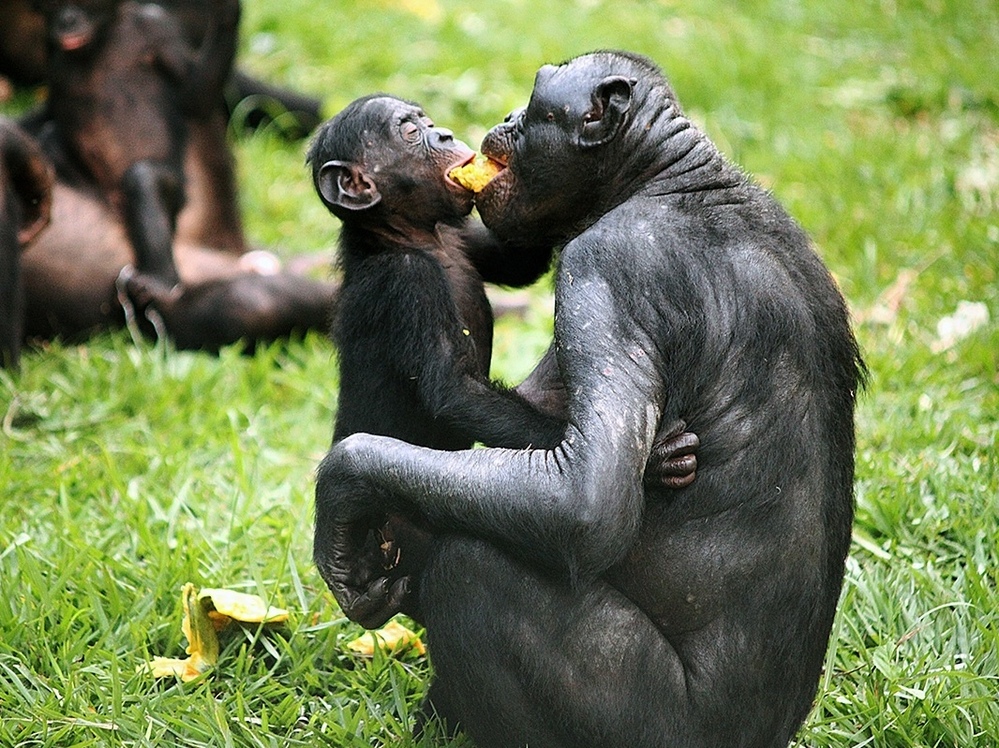
Bonobos share a piece of fruit at the Lola ya Bonobo sanctuary in the Democratic Republic of Congo. Enlarge image i

Bonobos share a piece of fruit at the Lola ya Bonobo sanctuary in the Democratic Republic of Congo.

Bonobos share a piece of fruit at the Lola ya Bonobo sanctuary in the Democratic Republic of Congo.

Bonobos share a piece of fruit at the Lola ya Bonobo sanctuary in the Democratic Republic of Congo.

Bonobos are another of our close relatives in the ape world. But unlike chimpanzees, bonobos live in groups run by females, and emphasize cooperation over competition. And like people, Bonobos use food to make new friends, not just to keep old ones.

Researchers showed this in a series of experiments done at the Lola Ya Bonobo sanctuary in the Democratic Republic of Congo.

The experiments involved a plate of food. "What we call it is the giant salad bowl, so we have apples, bananas, peanuts, papaya and cucumber all mixed together," says Jingzhi Tan, an evolutionary anthropologist at Duke University.

Researchers give the salad bowl to a bonobo in a locked enclosure. The bonobo has two neighbors in adjacent enclosures who don't have food. One of the neighbors is a bonobo they know, and one is a stranger.

Only the bonobo with the salad bowl can unlock the doors that would let a neighbor in. "So basically we create a situation that they can eat or they can share," Tan says.

And most of the time, the bonobo with the salad bowl did share but not with the bonobo they already knew. "The majority of the time, they chose to share with the stranger," Tan says.

What was most surprising, though, is that often the stranger who had just gotten access to the food would let the third bonobo in, and all three bonobos would eat together, Tan says.

And that brings us back to humans. It's not clear how long our human ancestors have been sharing food. But it appears that the social importance of food took a big leap forward about 1 million or 2 million years ago, says John Allen of the Brain and Creativity Institute at the University of Southern California. He's the author of The Omnivorous Mind, a book about how our relationship with food has evolved.

That's when humans began hunting really big animals, like mammoths, Allen says. The animals were so big that they couldn't be eaten by a small number of people. "That in effect provides a little arena for sharing and social exchange," Allen says.

In other words, the feast is born. Then when agriculture came along, we added harvest feasts, which eventually led to Thanksgiving.

And somewhere along the way, our brains became wired to remember these food events and the people associated with them, Allen says. It's probably no accident, he adds, that the digestive system produces hormones like insulin, leptin and ghrelin that act on the hippocampus, a part of the brain that plays a key role in memory.

Allen says the gut-brain connection probably exists because our ancestors were more likely to survive if they remembered clearly where they got their last good meal. And he says this same link between gut and brain is probably why he responds the way he does to a dish his mother used to make him called ketchup fried rice.

"Every time I make it I think of my mother," he says. Allen says he makes ketchup fried rice for his own children in hopes that they will always associate the dish with their father.

And if his kids really like that ketchup fried rice, another system in the brain will kick in to help create a lasting memory. It's the brain's dopamine system, which rewards us with feelings of pleasure.

The dopamine system becomes active in people when they look at someone they love or a favorite food, Allen says. So in our brains, at least, food really is connected to love and a sense of well-being.

And until recently that was probably a purely good thing, Allen says.

"There's never really been any incentive ever to limit calories," he says. "You know when you had a feast, when the food was there you ate it."

A lot of us still think that way. In the poll NPR did with the Robert Wood Johnson Foundation and the Harvard School of Public Health, about half of families said they treat celebrations as a time to take a break from concerns about overeating.

And in a world where it's possible to feast every day, that can be a problem. But it doesn't have to be, says Cassie, the cookbook author in Great Falls.

"You make that one day of celebration, or a weekend if you're going away for a weekend," she says. "But then you go back on Monday and you say, 'OK, now we have to get back to real life.' "

This story is part of the series On the Run: How Families Struggle to Eat Well and Exercise. The series is based on a poll from NPR, the Robert Wood Johnson Foundation and the Harvard School of Public Health. If you want to dive deeper, here's a summary of the poll findings, plus the topline data and charts.


The Function of the Human Brain - A Relationship Between Evolution ... A study of the human brain covering its evolution and development to obtain factual basis for human behavior. Health News & Articles Healthy Living - ABC News Get the latest health news from Dr. Richard Besser. Here you'll find stories about new medical research, the latest health care trends and health issues that affect ... How to Rewire Your Brain to End Food Cravings Dr. Mark Hyman Im a food addict. We all are. Our brains are biologically driven to seek and devour high-calorie, fatty foods. The difference is that I have learned how to control ... Human Evolution A study of the evolution of the human is necessary for the understanding of his cultural needs. Did humans really evolve from apes? - Yahoo! UK & Ireland Answers Best Answer: Sigh. Here we go again. >>>>did humans really evolve from apes? Yep, we evolved from apes and we are still apes. Humans are one of the 5 ... BRAINS PLUS BRAWN Edge.org Edge.org Print Mail Print HTML Complete your registration at Nidokidos Get Full Registration of Nidokidos Only 5 Easy Steps: 1: Start posting your files, photos, and articles. Join our forum today . Click here to register. Buddha's Brain: The Practical Neuroscience of Happiness, Love, and ... Books up to 50% Off Browse our Bookshelf Favorites store each month for big savings on popular fiction, nonfiction, children's books, and more.

Wednesday, February 27, 2013

Do Parents Really Know What Their Kids Are Eating?

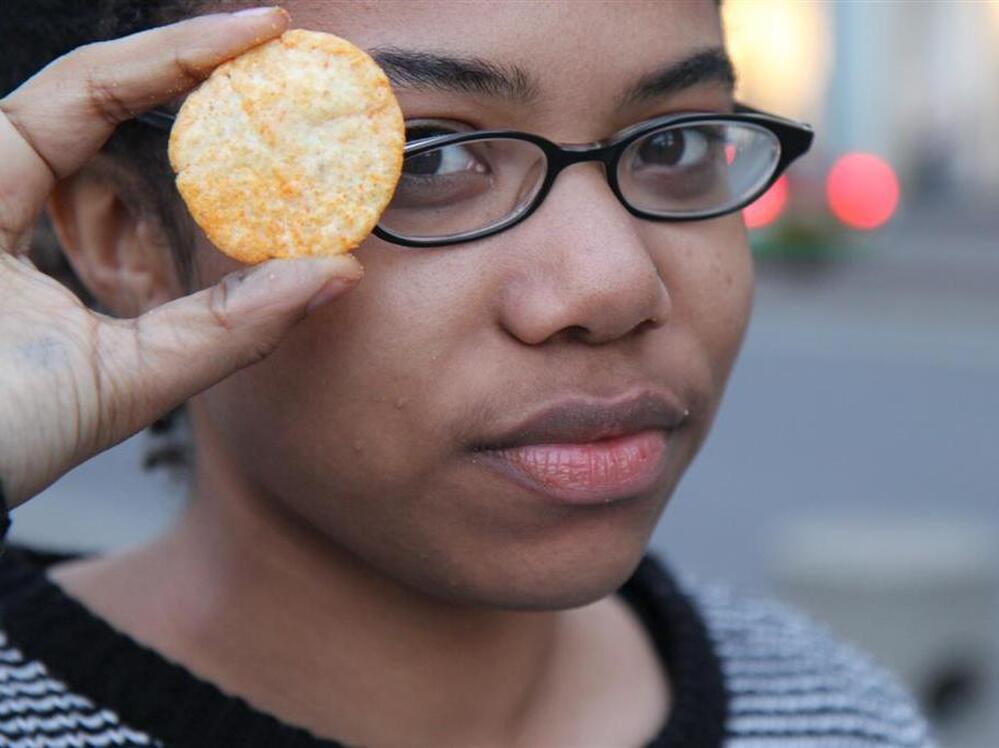
Youth Radio reporter Chantell Williams likes to munch on Popchips, which are marketed as a healthy snack. Enlarge image i

Youth Radio reporter Chantell Williams likes to munch on Popchips, which are marketed as a healthy snack.

Youth Radio reporter Chantell Williams likes to munch on Popchips, which are marketed as a healthy snack.

Youth Radio reporter Chantell Williams likes to munch on Popchips, which are marketed as a healthy snack.

After school and evening are "crunch time" for most families. It's the time when crucial decisions get made that affect kids' fitness and weight. And that includes snacking.

To get an idea of what parents thought their kids were doing during this time, NPR conducted a poll with the Robert Wood Johnson Foundation and the Harvard School of Public Health.

We also spoke to parents, like Deborah Richards from Oakland, Calif. She thinks she has a handle on her son Donta's eating habits.

"He's fussy but he eats healthy," she says. "He eats healthier than me."

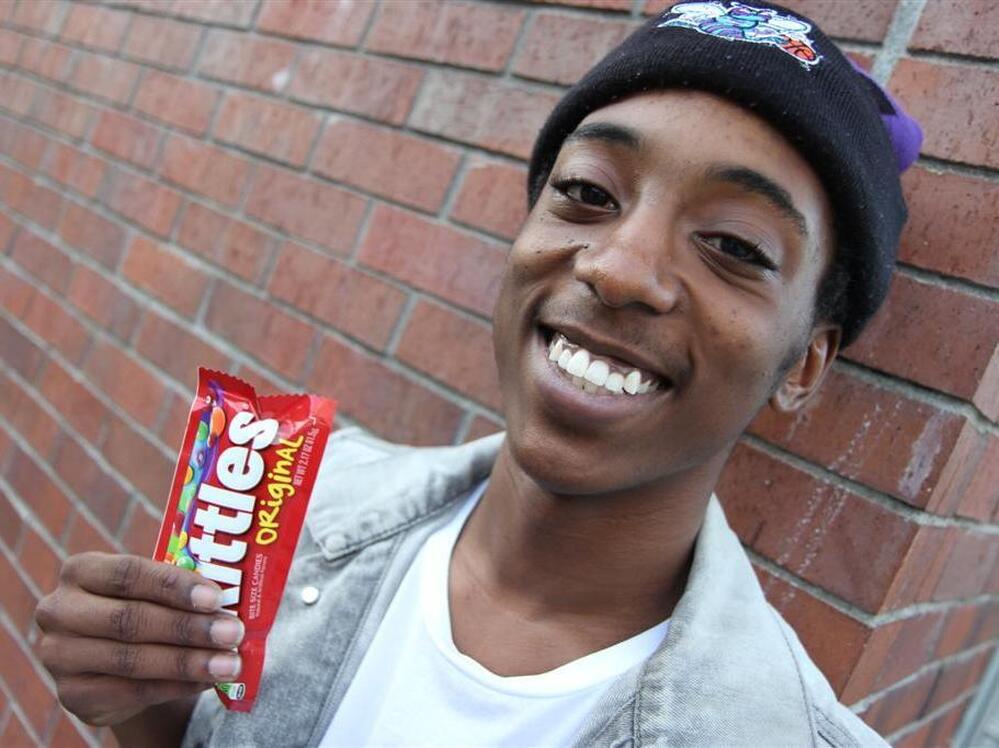
But Donta doesn't think so. "I know for a fact I don't," he says. "My breakfast, I can say on the daily, is a pack of Skittles. I make sure I get one every morning."

Donta Jackson's snack of choice is a bag of Skittles. Enlarge image i

Donta Jackson's snack of choice is a bag of Skittles.

Donta Jackson's snack of choice is a bag of Skittles.

Donta Jackson's snack of choice is a bag of Skittles.

"Skittles?!" gasps Richards. "I try to teach him better!"

Richards isn't alone. According to the poll, 87 percent of parents report their children are eating healthfully. But do parents really know what their kids especially older kids are eating?

Not according to high school senior Felix Pieske, from Portland, Maine.

"Middle school might have been the last time that I really talked to my parents about like, 'Oh, what did you eat today?' " he says.

I still talk to my mom, Oya Autry. She thinks I have a good diet lots of juices, water, fruits and salads, and not a lot of chips or fried foods.

And that sounds about right. Although, to be honest, I don't make it a point to keep track of what I eat.

However, some people, like 18-year-old Jorisha Mayo, know that they indulge, and do so starting right after school ends.

"I do occasionally eat unhealthy. I eat a lot of sugary foods and snacks," admits Mayo, from Concord, Calif. "I think I snack probably around the 3 to 4 [p.m.] zone. Then when it gets later, 11 or so, that's when I snack on my cookies and ice cream, and crackers or chips and stuff."

That's pretty normal. According to the poll, nearly half of children snacked on sweets, and a quarter ate chips the day before.

Lydia Tinajero, an expert on pediatric weight management at Oakland Children's Hospital, says some kids sneak their snacks.

"Some of the kids I work with that are overweight, they feel bad that they're eating things maybe they shouldn't," she says. "And so they sort of try and hide it, because at times they feel bad and they're a little embarrassed by it."

I don't intentionally hide food from my mom. But at the same time, I don't tell her every single thing I eat in a day, and she doesn't ask.

But for this assignment, I decided to keep a food diary, which I reviewed together with my mom.

I made some unhealthy choices during the week, including a bowl of crab fried rice and four Dorito chips for breakfast one day. But I also snacked on things like apples and granola bars.

Overall, my mom was pretty happy.

"Even those horrible snacks and weird breakfasts that I heard on the list, I think even those are still fairly healthy four Doritos versus four bags of Doritos," she says.

However, I'm not convinced. I've always thought of myself as a healthy eater, but when I look at my food diary, I'm less sure.

Which got me wondering, where do we teenagers get our ideas about what healthy even means?

"That's a good question: What does healthy mean?" says Tinajero. "With pediatrics, healthy is about being balanced. I always tell kids ... are you putting the best thing into your body?"

Tinajero says that if you're in tune with your body if you notice when you've had your fill of junk food for the week and decide to start eating better then you're body will begin to tell you what it needs.

Which means my mom doesn't have to.

This story was produced by Youth Radio (with additional reporting from Blunt Radio).

The story is part of the series On the Run: How Families Struggle To Eat Well and Exercise. The series is based on a poll from NPR, the Robert Wood Johnson Foundation and the Harvard School of Public Health. If you want to dive deeper, here's a summary of the poll findings, plus the topline data and charts.


I Am Adam Lanzas Mother: When Parents Are Afraid of Their ... Most parents in the U.S. have spent the past few days imagining what it would be like to be the mother or father of one of the 20 schoolchildren murdered ... Kids-In-Mind: Movie ratings & parents' reviews that actually work HUH? WHAT IS THIS? We enable adults to determine whether a movie is appropriate for them or their children, according to their own criteria. Eyewitness News Interaction - Typepad. Share your passions with ... Eyewitness News invites viewers to post their comments on topics of the day. Your comments may be displayed here or on Eyewitness News on WABC-TV in New York City. Children - How To Information eHow.com Describing your child's accomplishments and strengths is one really great way to help boost their self esteem. Describe your child's accomplishments and strengths ... North Korean parents 'eat their children' after being driven mad ... North Korean parents 'eating their own children' after being driven mad by hunger in famine-hit pariah state . Undercover reporters found a 'shocking' number of ... John Zuhlsdorf - Fr. Z's Blog What Does The Prayer Really Say ... Slavishly accurate translations and frank commentary - by Fr. John Zuhlsdorf. 'We know lots of things that we shouldn't know': Kids, parents ... NEWTOWN, Conn. -- It's not a conversation parents expect they'll have with their kids: But Shari and Andrew Paley were doing just that, talking with their identical ... Twenty Things Adopted Kids Wish Their Adoptive Parents Knew ... As both an adoptee and president of Jewel Among Jewels Adoption Network, Eldridge brings an original approach to the topic of adoption. In an attempt to inform ...